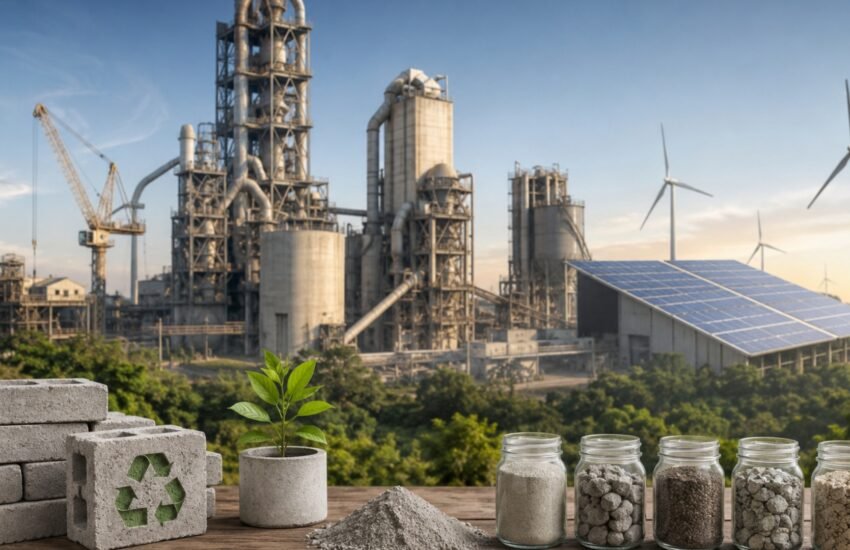
The cement and construction materials industry forms the backbone of modern infrastructure. From homes and hospitals to highways, bridges, and industrial facilities, cement is an indispensable material for economic development. However, the sector is also one of the largest contributors to global greenhouse gas (GHG) emissions, accounting for approximately 7–8% of global carbon dioxide (CO₂) emissions. As governments, investors, and customers increasingly prioritize sustainability, reducing the carbon footprint of cement and construction materials has become both an environmental responsibility and a business imperative.
Understanding the Carbon Footprint of Cement
A carbon footprint measures the total greenhouse gas emissions associated with a product, process, or organization. In cement manufacturing, emissions originate primarily from two sources:
- Process Emissions – During clinker production, limestone (calcium carbonate) is heated in kilns, releasing CO₂ as part of a chemical reaction. These emissions account for nearly 60% of cement-related emissions.
- Energy Emissions – The high-temperature kilns required for clinker production consume significant amounts of fuel and electricity, contributing approximately 40% of emissions.
Beyond cement production, the extraction, transportation, processing, and use of construction materials such as steel, aggregates, bricks, and concrete also contribute substantially to the industry’s overall carbon footprint.
Why Carbon Reduction Matters
Reducing carbon emissions is no longer solely about regulatory compliance. It offers several strategic advantages:
- Improved Environmental, Social, and Governance (ESG) performance
- Enhanced corporate reputation and stakeholder trust
- Reduced operational costs through energy efficiency
- Better access to sustainable financing and green investments
- Increased competitiveness in public and private procurement projects
- Long-term resilience against carbon pricing and environmental regulations
As the global construction sector moves toward net-zero goals, organizations that proactively reduce emissions will be better positioned to capture emerging market opportunities.
Key Strategies for Carbon Footprint Reduction
1. Reducing Clinker Content
Clinker is the most carbon-intensive component of cement. One of the most effective ways to reduce emissions is by lowering the clinker-to-cement ratio through the use of supplementary cementitious materials (SCMs).
Common SCMs include:
- Fly ash
- Ground granulated blast furnace slag (GGBS)
- Calcined clay
- Silica fume
- Natural pozzolans
These materials can significantly reduce embodied carbon while maintaining or even improving concrete performance. Blended cements are increasingly becoming the preferred choice for sustainable construction projects worldwide.
2. Improving Energy Efficiency
Energy optimization remains a critical pathway for carbon reduction. Cement manufacturers can improve efficiency through:
- Modern kiln technologies
- Waste heat recovery systems
- Variable frequency drives (VFDs)
- Advanced process controls and automation
- Efficient grinding technologies
Digital monitoring systems and predictive maintenance tools also help reduce energy losses and improve plant performance.
3. Transitioning to Alternative Fuels
Traditional fossil fuels such as coal and petcoke contribute significantly to emissions. Replacing them with alternative fuels can substantially reduce carbon intensity.
Examples include:
- Biomass residues
- Refuse-derived fuel (RDF)
- Municipal solid waste
- Agricultural waste
- Industrial by-products
Many leading cement producers have successfully increased their thermal substitution rates, reducing dependence on fossil fuels while supporting circular economy principles.
4. Renewable Energy Integration
Electricity consumption in cement plants can be partially or fully offset through renewable energy sources such as:
- Solar power
- Wind energy
- Green power purchase agreements (PPAs)
- Hybrid renewable energy systems
On-site renewable installations not only reduce emissions but also provide long-term energy cost stability.
5. Carbon Capture, Utilization, and Storage (CCUS)
Since process emissions from limestone calcination are unavoidable in conventional cement production, Carbon Capture, Utilization, and Storage (CCUS) technologies are emerging as a critical solution.
CCUS systems capture CO₂ before it enters the atmosphere and either:
- Store it underground safely
- Utilize it in industrial applications
- Convert it into valuable products such as synthetic fuels or building materials
While still developing commercially, CCUS is expected to play a major role in achieving net-zero cement production.
Sustainable Construction Materials
Reducing emissions extends beyond cement manufacturing. Construction companies can significantly lower embodied carbon by selecting sustainable materials.
Low-Carbon Concrete
Innovative concrete technologies incorporate:
- SCMs
- Recycled aggregates
- Carbon-cured concrete
- Geopolymer concrete
These alternatives can reduce lifecycle emissions while maintaining structural performance.
Recycled Materials
The use of recycled construction and demolition waste helps:
- Reduce landfill disposal
- Lower demand for virgin materials
- Minimize transportation emissions
- Support circular economy objectives
Materials such as recycled aggregates, reclaimed asphalt, and recycled steel are increasingly being integrated into construction projects.
Green Building Materials
Sustainable alternatives such as engineered timber, low-carbon bricks, and bio-based materials can complement traditional construction materials and reduce overall project emissions.
The Role of Life Cycle Assessment (LCA)
Life Cycle Assessment (LCA) is a valuable tool for measuring the environmental impact of construction materials from raw material extraction through manufacturing, transportation, use, and end-of-life disposal.
LCA enables organizations to:
- Identify emission hotspots
- Compare material alternatives
- Make informed design decisions
- Improve sustainability reporting
Many customers and project owners now require Environmental Product Declarations (EPDs), which are based on robust lifecycle assessments.
Digitalization and Smart Manufacturing
Industry 4.0 technologies are accelerating sustainability improvements in the cement sector.
Key digital solutions include:
- Artificial Intelligence (AI)-based process optimization
- Real-time energy monitoring
- Digital twins
- Predictive maintenance
- Automated quality control systems
These technologies improve operational efficiency while reducing energy consumption and emissions.
The Importance of Carbon Footprint Measurement
Organizations cannot manage what they do not measure. Establishing a comprehensive carbon inventory is the first step toward meaningful reduction.
Carbon footprint assessments help companies:
- Quantify Scope 1, Scope 2, and Scope 3 emissions
- Establish emission baselines
- Set science-based reduction targets
- Monitor progress over time
- Demonstrate commitment to sustainability
Recognition programs and sustainability certifications further encourage organizations to benchmark performance and showcase achievements.
Moving Toward Net-Zero Construction
Achieving net-zero emissions in the cement and construction materials industry will require collaboration across the value chain, including manufacturers, contractors, designers, policymakers, and customers. Innovations in materials, renewable energy adoption, circular economy practices, and carbon capture technologies will all play a vital role in this transformation.
Organizations that begin their carbon reduction journey today will not only contribute to global climate goals but also strengthen their market position, improve operational resilience, and create long-term value for stakeholders.
Conclusion
The cement and construction materials industry faces a significant challenge in reducing its carbon footprint, but it also holds immense potential to drive sustainable development. Through energy efficiency, alternative fuels, low-carbon materials, renewable energy, digital innovation, and robust carbon management practices, the sector can significantly reduce emissions while continuing to support economic growth and infrastructure development.
The future of construction is not just about building stronger structures—it is about building them responsibly. By embracing carbon footprint reduction strategies today, the industry can lead the transition toward a greener, more sustainable, and climate-resilient future.