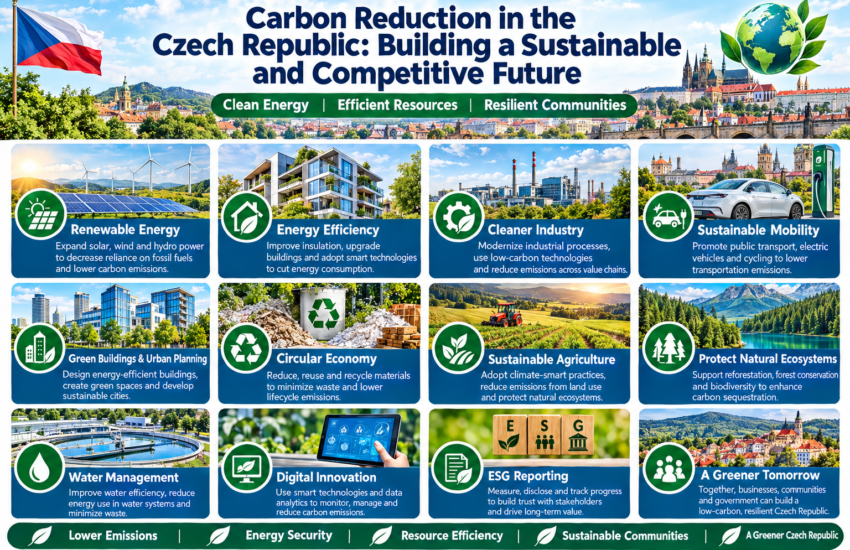
The Czech Republic is undergoing an important Energy Transition as businesses, industries, and public institutions respond to climate expectations, changing energy markets, and the growing importance of environmental responsibility. As a country with a strong industrial base, manufacturing plays an important role in the national economy while also creating significant opportunities for Carbon Footprint Reduction. Companies are increasingly looking beyond traditional energy efficiency and exploring Renewable Energy, Clean Energy, sustainable production, and responsible supply chains to reduce their environmental impact.
For Czech businesses, carbon reduction is becoming more than an environmental objective. It is increasingly connected with competitiveness, international market access, investor expectations, customer requirements, and ESG Compliance. Organizations that understand their Carbon Footprint and take practical steps toward Decarbonization can strengthen their position in both domestic and international markets.
Understanding the Carbon Footprint of Czech Businesses
A company’s Carbon Footprint represents the greenhouse gas emissions associated with its operations, energy consumption, transportation, production processes, and wider business activities. Understanding where these emissions originate is the foundation of effective carbon reduction.
Businesses can begin by examining Scope 1 Emissions, which are directly generated by sources owned or controlled by the organization. These may include fuel used in industrial equipment, company vehicles, heating systems, or manufacturing processes.
Scope 2 Emissions are associated with purchased electricity, heating, cooling, or steam. For many industrial and commercial organizations, reducing Scope 2 emissions can be achieved through improved energy efficiency, renewable electricity procurement, and the adoption of Clean Energy solutions.
The broader challenge is Scope 3 Emissions, which arise throughout the company’s value chain. These can include purchased materials, transportation, business travel, waste, distribution, product use, and other activities outside the organization’s direct control. Addressing Scope 3 emissions requires closer cooperation with suppliers, customers, logistics providers, and other business partners.
Renewable Energy and Clean Energy
The growth of Renewable Energy is an important component of carbon reduction in the Czech Republic. Businesses can explore solar energy, wind power, biomass, renewable electricity purchasing, and other clean energy solutions according to their operational requirements.
Industrial facilities can also combine renewable energy with energy-efficiency measures. Rooftop solar installations, energy-efficient machinery, smart energy management systems, efficient lighting, heat recovery, and improved building insulation can contribute to lower energy consumption.
Moving toward Clean Energy can also help organizations reduce their dependence on fossil fuels. However, the transition needs to be supported by proper planning. Companies should understand their current energy profile, identify major sources of consumption, and determine which technologies provide the most practical environmental and commercial benefits.
Decarbonization Across Industry
Decarbonization requires organizations to look beyond individual projects and develop a long-term strategy for reducing Carbon Emissions. For Czech industries, this may involve modernizing production systems, improving process efficiency, replacing fossil-fuel-based equipment, using lower-carbon materials, and increasing the use of renewable energy.
Manufacturing companies can integrate carbon reduction into procurement, facility management, production planning, logistics, and product development. Digital technologies can also support energy monitoring and help companies identify areas where resources are being unnecessarily consumed.
The goal is not simply to become Carbon Neutral through compensation. A stronger approach is to prioritize actual emissions reduction within business operations before considering external measures such as a Carbon Offset.
Carbon Credits and Carbon Offsets
Carbon Credits can play a supporting role in corporate climate strategies. They represent verified emission reductions or removals associated with eligible projects. Organizations may consider carbon credits when certain emissions cannot immediately be eliminated through operational improvements.
However, carbon credits should complement—not replace—genuine Carbon Footprint Reduction. Businesses should first focus on reducing energy consumption, improving efficiency, transitioning to renewable energy, and addressing emissions within their operations and value chains.
A responsible Carbon Offset strategy should therefore form part of a broader decarbonization plan. Companies should also evaluate the credibility, transparency, and environmental integrity of any carbon-credit projects they consider.
Building a Green Supply Chain
The transition toward a Green Supply Chain is increasingly important for companies operating in international markets. A business may reduce emissions within its own facilities while still having a substantial environmental impact through raw materials, transportation, packaging, suppliers, and outsourced activities.
Addressing Supply Chain Emissions requires companies to work collaboratively with suppliers. Organizations can introduce sustainability criteria into supplier selection, request environmental information, encourage energy efficiency, and prioritize suppliers that demonstrate credible sustainability practices.
Companies can also review logistics networks and explore lower-emission transportation options, optimized delivery routes, efficient packaging, and local sourcing where appropriate. These measures can contribute to both environmental performance and operational efficiency.
Sustainability Reporting and ESG Reporting
Transparency has become an important part of corporate sustainability. Sustainability Reporting enables organizations to communicate their environmental and social performance to stakeholders, customers, investors, employees, and business partners.
Similarly, ESG Reporting provides a structured way to demonstrate how environmental, social, and governance considerations are incorporated into business strategy. Carbon emissions, energy consumption, renewable energy adoption, waste management, supply-chain practices, and climate-related initiatives can all form part of a company’s sustainability communication.
For Czech companies working with international customers, credible sustainability information can also strengthen business relationships. Clear reporting helps demonstrate that environmental commitments are supported by measurable actions and responsible management practices.
ESG Compliance and European Market Expectations
As sustainability expectations continue to evolve across Europe, businesses are increasingly expected to understand their environmental impact and demonstrate progress. ESG Compliance is therefore becoming an important consideration for companies participating in European supply chains.
Czech manufacturers and exporters can benefit from preparing early. Establishing reliable emissions data, improving energy efficiency, strengthening supplier engagement, and developing sustainability policies can make organizations better prepared for evolving customer and regulatory expectations.
This preparation can also improve competitiveness. Companies with stronger environmental performance may be better positioned when international customers evaluate suppliers based on sustainability criteria.
The Path Toward Carbon Footprint Reduction
Successful Carbon Footprint Reduction requires a structured approach. Businesses can begin by understanding their current emissions profile and identifying the most significant sources of impact. They can then establish reduction priorities covering energy, production, transportation, procurement, waste, and supply-chain activities.
The next stage is implementation. Energy efficiency, Renewable Energy, cleaner technologies, responsible procurement, sustainable logistics, and employee engagement can collectively support meaningful reductions.
Progress should then be monitored and communicated through appropriate Sustainability Reporting and ESG Reporting practices. Where residual emissions remain, organizations can consider credible Carbon Credits and other carefully evaluated mechanisms.
Conclusion
The Czech Republic’s Energy Transition presents businesses with both a responsibility and an opportunity. Reducing Carbon Emissions can help organizations improve resource efficiency, strengthen resilience, respond to stakeholder expectations, and prepare for a more sustainability-focused European economy.
A successful strategy should go beyond individual environmental initiatives. It should connect Scope 1 Emissions, Scope 2 Emissions, and Scope 3 Emissions with energy management, renewable energy, supply-chain engagement, sustainability reporting, and long-term Decarbonization.
For Czech businesses, the journey toward a Carbon Neutral future begins with understanding their impact and taking practical action today. Through stronger Carbon Footprint Reduction, responsible energy choices, transparent reporting, and a Green Supply Chain, organizations can contribute to a cleaner future while building stronger and more competitive businesses.