The pulp and paper industry plays an important role in packaging, publishing, education, hygiene products, and industrial applications. However, paper production involves energy-intensive processes, substantial water consumption, chemical use, and the management of forestry resources and industrial waste. These activities can contribute significantly to a company’s environmental impact, making Carbon Footprint Reduction an important priority for pulp and paper manufacturers.
As customers, regulators, and investors increasingly emphasize sustainability, paper manufacturers are exploring cleaner production technologies, renewable energy, efficient resource utilization, and responsible sourcing. By integrating environmental management into their operations, companies can reduce their Carbon Footprint, strengthen competitiveness, and contribute to a more sustainable industrial future.
Understanding the Carbon Footprint of Paper Manufacturing
The carbon footprint of a pulp and paper facility includes greenhouse gas emissions generated directly by production activities and indirectly through purchased energy and other value-chain operations.
Scope 1 Emissions arise from sources directly controlled by a company, including fossil fuels burned in boilers, lime kilns, and other industrial equipment. Emissions may also arise from on-site vehicles and certain manufacturing processes.
Scope 2 Emissions are associated with purchased electricity, steam, heating, and cooling consumed during production. Paper mills operating energy-intensive machinery may have opportunities to reduce these emissions through renewable electricity procurement and improved energy efficiency.
Scope 3 Emissions occur across the wider value chain, including forestry operations, purchased pulp and chemicals, transportation, packaging materials, waste treatment, and the disposal or recycling of paper products.
Understanding these emission categories allows manufacturers to identify their major sources of environmental impact and develop targeted reduction strategies. Reliable emissions data also supports better decision-making and continuous improvement.
Renewable Energy and Clean Energy Adoption
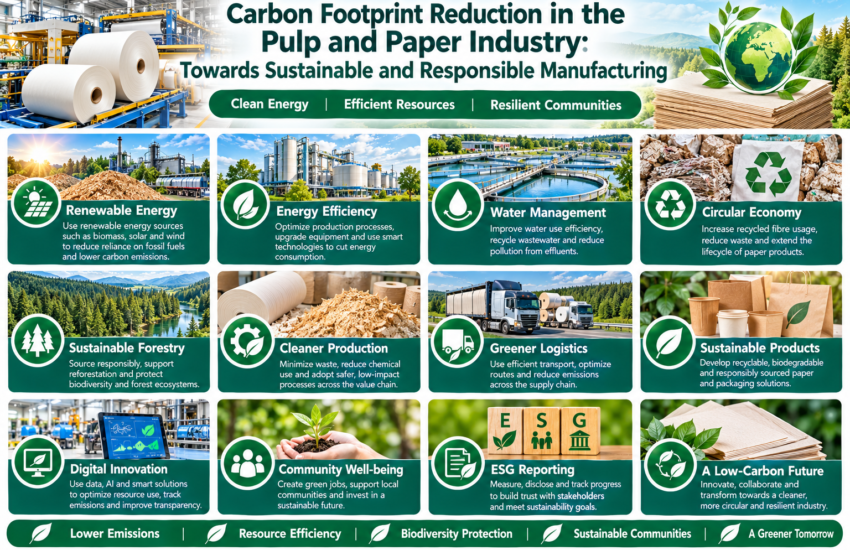
Energy consumption is a major consideration in pulp and paper manufacturing. Processes such as pulping, drying, pressing, and finishing require substantial thermal and electrical energy. Improving energy efficiency and adopting Renewable Energy can therefore support industrial decarbonization.
Many mills generate energy from biomass residues, including bark, wood chips, and other suitable by-products. When sourced and managed responsibly, biomass can contribute to energy recovery and reduce reliance on fossil fuels. However, its climate benefits depend on factors such as feedstock sourcing, forest regeneration, processing, transportation, and the time required for carbon stocks to recover.
Solar power, wind energy, and renewable electricity procurement can also help reduce the emissions associated with purchased energy. Manufacturers can assess opportunities to install solar panels, improve energy monitoring, recover waste heat, and optimize steam distribution.
Adopting Clean Energy should be combined with energy conservation and efficient equipment operation. These measures can help mills reduce energy waste while improving their environmental performance.
Decarbonization Through Efficient Manufacturing
Industrial Decarbonization requires a combination of technological improvements, operational changes, and long-term planning. In pulp and paper facilities, opportunities include modernizing boilers, optimizing drying systems, improving motor efficiency, reducing steam losses, and recovering heat from production processes.
Water management is another important area. Although water consumption does not directly represent carbon emissions in every instance, pumping, heating, treatment, and wastewater management require energy. Reducing freshwater consumption and improving wastewater treatment efficiency can therefore contribute to broader sustainability objectives.
Manufacturers can also improve material utilization by reducing production rejects, optimizing fibre recovery, and increasing the use of suitable recycled paper. Recycling can reduce demand for virgin fibre in appropriate applications, although its overall environmental benefits depend on collection systems, fibre quality, processing requirements, and energy sources.
A structured approach to reducing Carbon Emissions should begin with establishing an emissions baseline, identifying the most significant sources, and setting realistic improvement targets. Regular monitoring helps companies evaluate whether implemented measures are delivering the expected results.
Building a Green Supply Chain
A paper manufacturer’s environmental performance depends not only on activities within its facilities but also on the suppliers and customers connected to its operations. Forestry practices, pulp sourcing, chemical production, transportation, and waste management can all influence Supply Chain Emissions.
Developing a Green Supply Chain involves selecting responsible suppliers, improving transportation efficiency, strengthening sustainable forestry practices, and encouraging suppliers to disclose relevant environmental information.
Manufacturers can work with forestry partners to promote responsible forest management, protect biodiversity, and maintain traceability of wood-based materials. Procurement teams can also evaluate suppliers based on environmental performance, resource efficiency, and appropriate sustainability certifications.
Transportation emissions can be reduced through improved route planning, efficient vehicle utilization, optimized delivery schedules, and greater use of lower-emission transport options where practical.
Collaboration throughout the value chain is essential because manufacturers may have limited direct control over some sources of Scope 3 Emissions. Engaging suppliers and customers can help identify shared opportunities for reducing environmental impacts.
ESG Reporting and Sustainability Transparency
Environmental responsibility is increasingly linked to corporate accountability and stakeholder expectations. ESG Reporting allows companies to communicate their environmental, social, and governance performance, while Sustainability Reporting provides information about sustainability objectives, risks, policies, and progress.
For pulp and paper manufacturers, relevant disclosures may cover energy consumption, greenhouse gas emissions, water use, wastewater treatment, waste generation, fibre sourcing, employee safety, and supplier practices.
Effective ESG Compliance requires organizations to identify the reporting and regulatory requirements applicable to their operations and maintain reliable supporting documentation. Businesses operating across different markets should also review relevant customer requirements and applicable environmental legislation.
Transparent reporting helps companies identify performance gaps, strengthen internal accountability, and communicate progress to investors, customers, employees, and business partners.
Manufacturers should ensure that environmental claims are accurate, clearly defined, and supported by appropriate evidence. Reporting should acknowledge significant impacts and improvement areas rather than focusing exclusively on positive achievements.
Carbon Credits and Carbon Offsets
Some pulp and paper manufacturers may consider Carbon Credits as part of a broader climate strategy. Credits may represent verified emissions reductions or removals generated by eligible projects, depending on the applicable programme and its requirements.
Forestry restoration, ecosystem conservation, and other eligible climate initiatives may generate carbon credits when they meet appropriate standards. However, the climate benefits depend on credible measurement, additionality, permanence, and safeguards against unintended environmental and social impacts.
A Carbon Offset may be used to compensate for emissions that remain after feasible reduction measures have been implemented. Nevertheless, offset purchases should not replace direct reductions in fuel consumption, electricity use, process emissions, or supply chain impacts.
A Carbon Neutral claim should be made only when the emissions boundary, accounting approach, reduction measures, residual emissions, and treatment of offsets are clearly defined and substantiated. Companies should communicate their climate strategies transparently and avoid overstating the environmental benefits of individual initiatives.
The Energy Transition and the Path Towards Sustainability
The Energy Transition presents both challenges and opportunities for pulp and paper manufacturers. Moving towards lower-carbon production may require investments in efficient equipment, renewable energy systems, electrification, alternative fuels, and improved process controls.
Companies can prioritize projects according to emissions reduction potential, technical feasibility, operational reliability, and financial considerations. Collaboration with technology providers, energy suppliers, research institutions, and sustainability specialists can support the implementation of appropriate solutions.
Carbon Footprint Reduction should be treated as an ongoing business improvement process rather than a one-time exercise. Establishing clear targets, assigning responsibilities, monitoring performance, and reviewing results regularly can help organizations maintain progress.
Conclusion
The pulp and paper industry can contribute to a more sustainable future by improving energy efficiency, adopting renewable energy, strengthening responsible fibre sourcing, reducing waste, and engaging suppliers. A comprehensive approach to emissions management helps manufacturers understand their environmental impacts and identify practical opportunities for improvement.
By integrating decarbonization into manufacturing operations, strengthening ESG practices, and communicating sustainability performance transparently, pulp and paper companies can improve resource efficiency and build stronger relationships with stakeholders.