The food and agriculture industry is fundamental to global food security, economic development, and livelihoods. At the same time, agricultural production, food processing, transportation, refrigeration, packaging, and waste management contribute significantly to environmental pressures. Growing demand for food, changing consumption patterns, resource-intensive production, and climate-related risks are encouraging businesses across the value chain to measure and reduce their environmental impact. Carbon Footprint Reduction has therefore become an increasingly important component of responsible food and agricultural business management.
Understanding the Carbon Footprint of Food and Agriculture
The Carbon Footprint of a food or agricultural business represents the greenhouse gas emissions associated with its operations, products, and value chain. These emissions can originate from farm machinery, irrigation systems, fertilizer application, livestock activities, processing facilities, refrigeration, transportation, packaging, storage, and disposal.
For agricultural organizations, Scope 1 Emissions generally include direct emissions from owned or controlled sources, such as diesel-powered machinery, company vehicles, boilers, generators, and fuel combustion. Agricultural operations may also generate emissions through livestock management, fertilizer use, and other production activities.
Scope 2 Emissions arise from purchased electricity, heating, cooling, and steam consumed by farms, processing facilities, warehouses, offices, and distribution centers. Improving energy efficiency and increasing the use of renewable electricity can significantly reduce emissions associated with these activities.
A considerable proportion of emissions can also occur beyond the organization’s direct operations. Scope 3 Emissions cover indirect emissions throughout the broader value chain, including purchased agricultural inputs, packaging materials, transportation, food processing undertaken by third parties, business activities, product distribution, consumer use, and waste disposal. Understanding these sources enables companies to identify emissions hotpots that cannot be addressed through operational improvements alone.
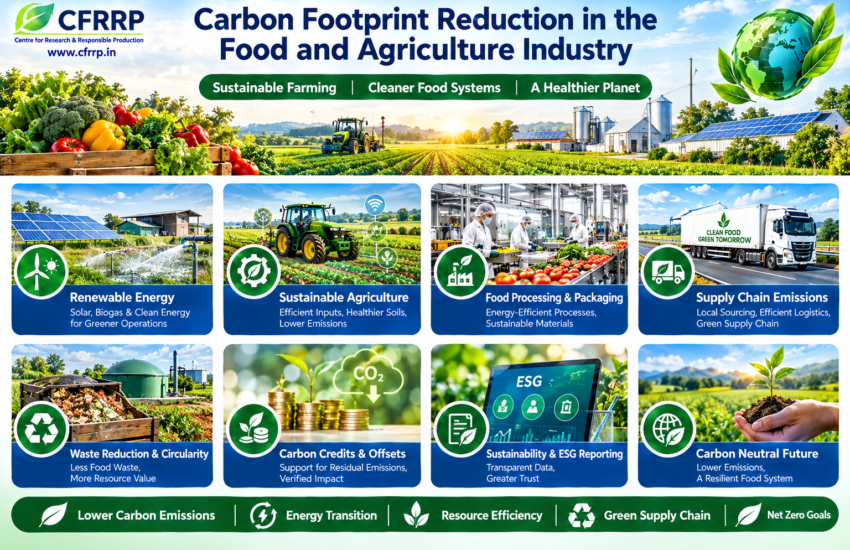
Renewable Energy and Clean Energy in Agriculture
Energy consumption is an important consideration across modern agricultural and food-processing operations. Irrigation pumps, cold storage, processing equipment, heating systems, refrigeration units, and warehouses can require substantial amounts of electricity and fuel.
Adopting Renewable Energy can help businesses reduce dependence on fossil fuels. Solar photovoltaic systems can be deployed on agricultural buildings, warehouses, processing facilities, and unused land. Solar-powered irrigation and water pumping can also provide alternatives to conventional diesel-powered systems.
The transition toward Clean Energy can extend beyond electricity generation. Food processors can explore renewable heat, bio gas, biomass sourced responsibly from agricultural residues, electric machinery, and energy-efficient refrigeration. Energy audits can identify inefficient equipment and processes, helping organizations prioritize investments that reduce both energy consumption and emissions.
This broader Energy Transition requires businesses to consider energy sourcing, technology upgrades, operational efficiency, and long-term infrastructure planning together rather than treating renewable energy as an isolated initiative.
Sustainable Agricultural Practices
Agricultural production offers several opportunities for reducing environmental impact while improving resource efficiency. Soil management, precision agriculture, efficient irrigation, responsible fertilizer application, agroforestry, crop diversification, and improved livestock practices can contribute to lower emissions.
Precision agriculture technologies can help farmers apply water, fertilizers, pesticides, and other inputs according to actual crop requirements. This can reduce resource wastage while supporting productivity. Improved soil management can also contribute to healthier soils and better carbon management.
Agricultural residues can be utilized productively through composting, bio energy generation, or other circular approaches. Reducing open burning of residues can help avoid unnecessary emissions and improve local environmental conditions.
For livestock operations, improved feed management, manure management, breeding practices, and renewable energy integration can contribute to emissions reduction. These approaches demonstrate that Decarbonization in agriculture involves a combination of technology, farm management, resource efficiency, and ecological practices.
Addressing Supply Chain Emissions
Food products typically pass through multiple stages before reaching consumers. Farmers purchase inputs, agricultural products are transported to processing facilities, food is packaged and stored, and finished products are distributed through various channels.
Supply Chain Emissions can therefore represent a significant area of focus for food companies. Businesses can work with suppliers to improve energy efficiency, reduce unnecessary transportation, adopt sustainable farming methods, and increase transparency regarding environmental performance.
Developing a Green Supply Chain involves integrating environmental considerations into procurement, supplier selection, logistics, packaging, warehousing, and distribution. Companies can encourage suppliers to measure their emissions and establish reduction targets.
Local and regional sourcing, optimized transportation routes, improved vehicle utilization, low-emission logistics, and efficient cold-chain infrastructure can further contribute to reducing the environmental impact of food distribution.
Reducing Waste Across the Food Value Chain
Food loss and waste create environmental impacts because the resources used to produce, process, transport, refrigerate, and package food are effectively wasted when products are discarded.
Businesses can reduce waste by improving demand forecasting, inventory management, storage conditions, packaging design, production planning, and distribution systems. Technologies that extend shelf life can also reduce losses during transportation and retail.
Agricultural and food-processing residues can potentially be redirected toward animal feed, composting, bio energy, or other productive applications where appropriate. These approaches support resource efficiency and contribute to a more circular food system.
Carbon Credits and Carbon Offsets
After implementing direct emissions-reduction measures, companies may consider mechanisms such as Carbon Credits and Carbon Offset programs for residual emissions. Carbon credits represent quantified emissions reductions or removals associated with eligible projects, while offsets may be used by organizations to compensate for emissions through verified activities outside their direct operations.
However, these mechanisms should complement rather than replace operational emissions reduction. Companies seeking credible climate strategies can prioritize measurable reductions within their own operations and value chains before addressing unavoidable residual emissions through appropriate mechanisms.
Organizations should also evaluate the quality, verification, additionality, permanence, and transparency of any carbon-credit or offset projects they consider.
Sustainability Reporting and ESG Transparency
Measurement is essential for understanding whether climate initiatives are producing meaningful results. Sustainability Reporting enables organizations to communicate information about emissions, energy consumption, resource use, waste, water, climate initiatives, and other environmental indicators.
ESG Reporting can provide stakeholders with a broader view of environmental, social, and governance performance. Food and agricultural companies can use ESG disclosures to demonstrate progress toward emissions-reduction objectives while improving transparency across their value chains.
Effective reporting should be supported by reliable data collection systems. Organizations can establish consistent methodologies for tracking fuel consumption, electricity use, agricultural inputs, transportation, waste, and other relevant activities.
ESG Compliance and Business Resilience
Growing expectations from customers, investors, regulators, financial institutions, and supply-chain partners are increasing the importance of ESG Compliance. Food companies with transparent environmental data and structured climate strategies may be better positioned to respond to changing reporting requirements and customer expectations.
Carbon management can also contribute to business resilience. Energy efficiency can reduce exposure to volatile energy costs, while resource-efficient agricultural practices can improve resilience to water scarcity, changing weather conditions, and resource constraints. Sustainable procurement can strengthen supply-chain resilience by encouraging suppliers to improve resource and environmental management.
Building a Carbon Neutral Food System
The transition toward Carbon Neutral operations requires a long-term strategy rather than a single project. Companies can establish emissions baselines, identify high-impact sources, define reduction targets, implement operational improvements, and monitor performance over time.
A comprehensive strategy may combine renewable electricity, energy efficiency, sustainable agriculture, low-carbon logistics, responsible packaging, waste reduction, supplier engagement, and credible approaches to residual emissions.
The Future of Carbon Footprint Reduction in Food and Agriculture
The future of the food and agriculture industry will increasingly depend on its ability to produce sufficient food while managing environmental resources responsibly. Digital agriculture, renewable energy, precision farming, efficient cold chains, sustainable inputs, circular resource use, and transparent emissions measurement can support this transformation.
Carbon Footprint Reduction is therefore not simply an environmental initiative. It can become part of a broader strategy for operational efficiency, supply-chain resilience, resource conservation, regulatory preparedness, and long-term competitiveness.
For food producers, agricultural enterprises, processors, retailers, and logistics providers, the pathway forward involves understanding emissions across the entire value chain and translating measurement into practical action. By combining efficient production with clean energy, responsible sourcing, sustainable agriculture, and transparent reporting, the industry can move toward a lower-carbon food system while continuing to meet the world’s growing demand for food.