Introduction of Carbon Footprint
Italy is steadily strengthening its commitment to environmental sustainability, with carbon footprint reduction becoming an important priority across its industrial, commercial and public sectors. Known for its manufacturing excellence, automotive industry, fashion and textiles, food processing, construction, tourism and engineering capabilities, Italy faces the challenge of maintaining economic competitiveness while transitioning towards a low-carbon economy.
Climate change, rising energy costs, environmental regulations and growing expectations from international customers are encouraging Italian businesses to rethink their production methods, energy consumption and supply chain operations. Carbon footprint reduction is no longer simply an environmental responsibility; it is increasingly becoming an important part of business strategy, operational efficiency and international competitiveness.
Italy’s transition towards a greener economy is supported by national climate policies, European Union sustainability regulations, renewable energy investments and initiatives promoting resource efficiency and circular manufacturing.
Italy’s Commitment to Carbon Footprint Reduction
Italy’s climate ambitions are closely aligned with the European Green Deal and the European Union’s broader objective of achieving climate neutrality. Its Integrated National Energy and Climate Plan provides a strategic framework for reducing greenhouse gas emissions, improving energy efficiency, expanding renewable energy and strengthening energy security.
The country is working towards a cleaner energy system through the development of solar power, wind energy, hydropower and other renewable sources. Reducing dependence on fossil fuels while improving the efficiency of electricity generation and consumption remains central to this transition.
Italy has already made progress in reducing greenhouse gas emissions through changes in energy consumption, industrial processes and environmental policies. However, continued efforts are necessary to accelerate decarbonisation, particularly in transportation, buildings, manufacturing and energy-intensive activities.
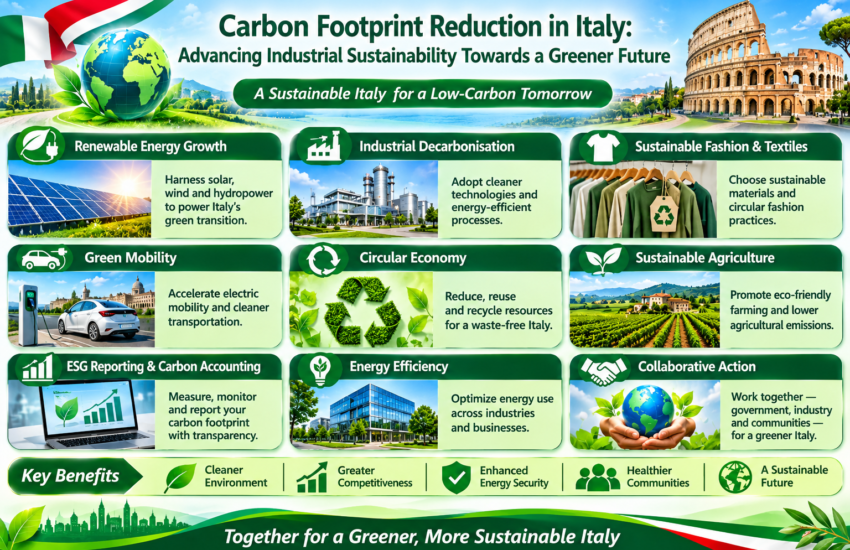
Renewable Energy: Powering Italy’s Green Transition
Renewable energy is an important pillar of Italy’s carbon footprint reduction strategy. The country’s geographical conditions provide considerable opportunities for solar energy, while its coastal regions and suitable inland locations offer potential for wind power development.
Solar photovoltaic installations are increasingly being adopted by industrial facilities, commercial buildings and residential properties. Manufacturing companies are investing in rooftop solar panels to generate electricity for their operations, reduce dependence on conventional energy sources and improve their environmental performance.
Hydropower also contributes significantly to Italy’s renewable electricity generation. Meanwhile, wind energy development is creating opportunities to diversify the national energy mix.
Businesses are additionally exploring renewable electricity procurement agreements and energy management solutions to reduce their Scope Two emissions.
The expansion of renewable energy is particularly important for manufacturing companies that require substantial electricity for machinery, production lines, heating, cooling and other industrial operations.
Industrial Decarbonization and Sustainable Manufacturing
Manufacturing is an essential part of the Italian economy. Industries such as automotive, machinery, steel, chemicals, cement, ceramics, textiles, fashion and food processing play an important role in international trade and industrial development.
However, manufacturing activities generate greenhouse gas emissions through electricity consumption, fuel combustion, industrial processes, raw material extraction and transportation.
Italian manufacturers are increasingly exploring cleaner production methods, energy-efficient equipment, process optimisation and alternative materials.
Industrial facilities can reduce their carbon footprint by replacing outdated machinery, improving insulation, recovering waste heat, optimising production schedules and introducing automated energy monitoring systems.
The automotive and engineering industries are also moving towards electric mobility, lightweight materials, energy-efficient manufacturing and sustainable component sourcing.
For energy-intensive industries, the transition requires investments in cleaner fuels, electrification, renewable energy and innovative production technologies.
Sustainable manufacturing is therefore becoming an important factor in maintaining Italy’s position as a competitive European industrial economy.
Carbon Footprint Reduction in the Fashion and Textile Industry
Italy is internationally recognised for its fashion, luxury goods, textiles and leather manufacturing industries. However, these industries face increasing pressure to address emissions associated with raw materials, textile processing, dyeing, finishing, packaging and international distribution.
The textile industry can reduce its environmental impact through sustainable fibre sourcing, recycled fabrics, water-efficient dyeing processes and cleaner manufacturing technologies.
Companies are increasingly exploring recycled cotton, organic fibres, responsibly sourced materials and innovative alternatives to conventional synthetic fabrics.
Circular fashion is another important opportunity. Encouraging product durability, repair, reuse, recycling and responsible waste management can reduce the demand for virgin materials and limit waste generation.
Fashion brands and manufacturers are also expected to improve supply chain transparency and demonstrate greater accountability for their environmental impact.
For Italian textile exporters, adopting sustainable manufacturing practices can strengthen relationships with international buyers and support compliance with evolving European sustainability requirements.
Sustainable Transportation and Green Mobility
Transportation remains an important area for carbon footprint reduction in Italy. Road transport, freight movement, aviation and logistics contribute to greenhouse gas emissions and urban air pollution.
Italy is encouraging the transition towards cleaner mobility through electric vehicles, charging infrastructure, public transportation improvements and sustainable urban mobility initiatives.
The automotive industry is exploring electric vehicle technologies, battery development and cleaner production processes. At the same time, companies are evaluating opportunities to optimise freight transportation, improve vehicle utilisation and reduce unnecessary logistics movements.
Rail transportation offers an alternative to road freight for suitable routes, helping businesses reduce transportation-related emissions.
Italian logistics companies can further improve their environmental performance through route optimisation, warehouse energy efficiency, alternative fuels and better coordination of distribution networks.
Circular Economy and Waste Management
Italy has a well-established interest in circular economy practices, making resource efficiency and waste reduction important components of its sustainability transition.
The circular economy focuses on keeping materials and products in use for longer rather than following a traditional model of production, consumption and disposal.
Manufacturing companies can reduce their environmental impact by reusing industrial by-products, recycling production waste, reducing packaging materials and improving material recovery.
The food processing industry can explore solutions for agricultural residue utilisation, food waste reduction and sustainable packaging. Construction companies can promote the recovery and reuse of demolition materials, metals, glass and other construction resources.
Better waste segregation, recycling infrastructure and responsible disposal practices can also reduce emissions associated with landfill operations.
By adopting circular economy principles, Italian businesses can improve resource productivity while reducing waste generation and environmental costs.
Sustainable Agriculture and Food Processing
Agriculture and food production are important parts of Italy’s economy and cultural identity. Wine production, dairy, olive oil, fruit cultivation and food processing are closely connected to the country’s regional industries.
However, agricultural activities contribute to greenhouse gas emissions through fertiliser use, livestock management, agricultural machinery, irrigation and food transportation.
Sustainable agricultural practices can help address these challenges through efficient water management, responsible fertiliser application, soil conservation, organic farming and improved livestock waste management.
Food processing companies can reduce their carbon footprint through energy-efficient refrigeration, renewable electricity, improved packaging and the utilisation of agricultural by-products.
Promoting local sourcing and reducing food losses throughout the supply chain can further support environmental sustainability.
ESG Reporting and Carbon Accounting
As environmental expectations increase, Italian companies are placing greater emphasis on carbon accounting, sustainability reporting and Environmental, Social and Governance practices.
Understanding emissions across Scope One, Scope Two and Scope Three is essential for identifying the sources of an organisation’s carbon footprint.
Scope One covers direct emissions from company-owned or controlled sources. Scope Two accounts for indirect emissions associated with purchased electricity, heating and cooling. Scope Three includes other indirect emissions across the value chain, such as purchased materials, transportation, business travel, product use and waste disposal.
Accurate carbon accounting enables organisations to identify emission-intensive operations, establish reduction priorities and monitor environmental performance.
European sustainability reporting requirements are also encouraging companies to strengthen their environmental disclosures and improve the quality of sustainability-related information.
For Italian manufacturers supplying international markets, carbon transparency can become an important factor in maintaining customer relationships and strengthening supply chain competitiveness.
Challenges in Italy’s Carbon Footprint Reduction Journey
Despite its progress, Italy faces several challenges in accelerating its low-carbon transition.
Dependence on natural gas and other fossil fuels continues to influence energy costs and industrial emissions. Renewable energy expansion also requires improved infrastructure, grid connectivity, investment and streamlined project approvals.
Small and medium-sized enterprises may face financial and technical difficulties in adopting cleaner technologies, conducting carbon audits and implementing sustainability reporting systems.
Energy-intensive industries require substantial investments to transform existing production infrastructure without affecting operational efficiency or international competitiveness.
Supply chain emissions present another challenge because businesses often depend on suppliers, transportation providers and raw material producers whose environmental performance may be difficult to assess.
Addressing these barriers requires cooperation between government institutions, financial organisations, industry associations, technology providers and individual businesses.
The Road Ahead: Building a Low-Carbon Italian Economy
Italy’s carbon footprint reduction journey represents an opportunity to strengthen its industrial capabilities while creating a more sustainable economic future.
Renewable energy adoption, cleaner manufacturing, circular economy practices, green mobility and transparent ESG reporting will remain important areas of development.
Businesses that proactively understand their environmental impact will be better positioned to identify operational inefficiencies, respond to customer expectations and prepare for evolving European environmental requirements.
Carbon footprint reduction should not be viewed as an isolated compliance activity. It must become an ongoing business process supported by reliable data, measurable objectives, employee participation and continuous improvement.
Conclusion
Italy’s transition towards a low-carbon economy demonstrates the importance of combining industrial competitiveness with environmental responsibility. From manufacturing and automotive production to fashion, agriculture, transportation and energy, every sector has an opportunity to contribute to a greener future.
For Italian businesses, understanding their carbon footprint is the starting point for meaningful environmental improvement. Measuring emissions, identifying reduction opportunities, adopting cleaner technologies and strengthening sustainability reporting can help organisations build resilience and maintain their position in increasingly sustainability-conscious international markets.
A greener Italy will depend not only on national policies and renewable energy investments but also on the commitment of individual companies to make carbon footprint reduction an integral part of their business strategy.
A sustainable future begins with understanding your carbon footprint and taking meaningful action to reduce it.