Introduction
Carbon Footprint Reduction has therefore become an important consideration for Hungarian businesses seeking to improve operational efficiency, strengthen environmental responsibility and remain competitive in international markets. From automotive manufacturing and electronics production to agriculture, construction and energy, organizations are increasingly required to understand their environmental impact and adopt practical decarbonization strategies.
Hungary is steadily strengthening its position in Europe’s transition towards a more sustainable and climate-resilient economy. With a manufacturing-driven industrial base, a growing renewable energy sector and increasing integration into European supply chains, the country has significant opportunities to accelerate its green transformation. However, rising energy demand, dependence on fossil fuels, transportation emissions and resource-intensive industrial activities continue to create environmental challenges.
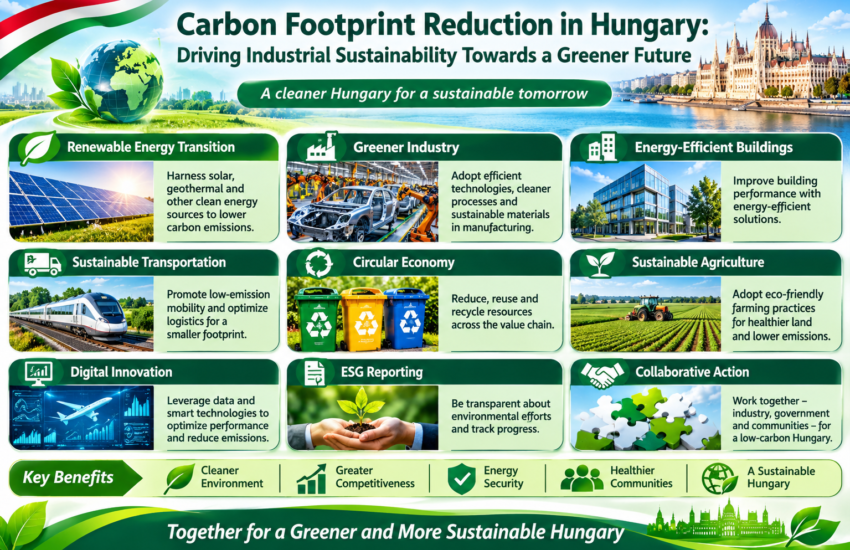
Hungary’s transition towards a climate-neutral economy requires collaboration between industries, government institutions, investors and consumers. By integrating Renewable Energy, energy-efficient technologies, responsible resource management and transparent ESG Reporting, the country can create a stronger foundation for sustainable economic development.
Hungary’s Renewable Energy Transition and Carbon Reduction Opportunities
Energy consumption remains a significant contributor to Hungary’s Carbon Footprint. The country’s energy transition is increasingly supported by solar power, geothermal energy, biomass and improvements in electricity infrastructure. Solar energy has emerged as a particularly important contributor to the renewable energy landscape, creating opportunities for industrial facilities to reduce their dependence on conventional electricity sources.
Manufacturing organizations can accelerate this transition by installing rooftop solar systems, entering renewable electricity procurement agreements and exploring opportunities for on-site energy generation. Combining renewable electricity with energy storage solutions can also improve energy security and help businesses manage fluctuations in energy demand.
Geothermal energy offers another promising opportunity, particularly for heating applications and district heating networks. Its effective utilization can reduce dependence on natural gas while supporting cleaner heating solutions for residential, commercial and industrial facilities.
For Hungarian businesses, adopting Clean Energy is not simply an environmental commitment. It can also strengthen energy independence, improve long-term operational resilience and support the transition towards lower-carbon production systems.
Decarbonizing Hungary’s Automotive and Manufacturing Industries
Hungary has developed a strong manufacturing ecosystem, particularly in automotive production, vehicle components, electronics, machinery and industrial equipment. The country’s growing importance in European automotive and battery supply chains creates significant opportunities for sustainable industrial development.
However, manufacturing activities generate emissions through electricity consumption, industrial heating, raw material processing, chemical operations and transportation. These activities contribute to both Scope 1 Emissions and Scope 2 Emissions, while purchased materials, logistics and product distribution create additional Scope 3 Emissions.
Manufacturers can address these environmental impacts through efficient production planning, electrification of industrial processes, low-carbon raw material sourcing and the adoption of modern energy management systems.
Automotive suppliers can also work towards reducing the environmental impact of component manufacturing by introducing lightweight materials, improving production efficiency and encouraging the use of recycled metals and plastics.
Battery manufacturing presents another important sustainability consideration. Responsible sourcing of critical minerals, efficient water consumption, improved chemical management and battery recycling can help reduce the environmental impact throughout the product lifecycle.
Companies that integrate Carbon Footprint Reduction into their manufacturing strategies can strengthen their position as responsible suppliers to European automotive manufacturers and international business partners.
Energy Efficiency and Sustainable Buildings
Buildings represent an important area for Hungary’s decarbonization efforts. Residential properties, commercial establishments, warehouses and industrial buildings consume considerable energy for heating, cooling, lighting and ventilation.
Older buildings with inadequate insulation and inefficient heating systems can increase energy consumption and contribute to unnecessary Carbon Emissions. Improving building performance is therefore essential for reducing environmental impact.
Organizations can introduce energy-efficient lighting, automated building management systems, high-performance insulation, heat pumps and modern ventilation technologies. Industrial facilities can further improve efficiency through waste heat recovery, optimized temperature controls and intelligent energy monitoring.
Sustainable building practices should also extend to construction materials. Recycled steel, low-carbon concrete, responsibly sourced timber and environmentally preferable insulation materials can reduce the embodied carbon associated with construction activities.
By incorporating sustainability into building design, renovation and maintenance, Hungarian organizations can achieve long-term energy savings while creating healthier working and living environments.
Sustainable Transportation and Green Logistics
Hungary’s geographical position makes it an important transportation and logistics connection between Central and Western Europe. Its road networks, industrial corridors and cross-border trade activities support the movement of manufactured goods and agricultural products.
Nevertheless, road transportation remains a significant source of Carbon Emissions. Heavy-duty vehicles, conventional passenger cars and fuel-intensive freight operations contribute to the environmental impact of the transportation sector.
Businesses can reduce these emissions by improving logistics planning, consolidating shipments, optimizing delivery routes and reducing unnecessary vehicle movements. Greater utilization of railway freight can provide an alternative to long-distance road transportation wherever infrastructure and operational requirements permit.
The adoption of electric vehicles, alternative-fuel vehicles and low-emission public transportation can further support cleaner mobility. Companies can also introduce employee transportation programmes, vehicle-sharing arrangements and charging infrastructure at workplaces.
For logistics operators, monitoring fuel consumption, vehicle utilization and transportation-related Supply Chain Emissions can identify opportunities for operational improvements and more sustainable distribution networks.
Sustainable Agriculture and Responsible Resource Management
Agriculture plays an important role in Hungary’s economy and environmental landscape. However, agricultural activities can generate greenhouse gas emissions through livestock production, fertilizer application, soil management, agricultural machinery and food processing.
Sustainable agricultural practices can help reduce these environmental pressures while protecting soil quality and water resources.
Farmers can adopt precision agriculture, efficient irrigation systems, improved fertilizer management and responsible livestock practices. Crop rotation, conservation agriculture and organic soil management can support healthier agricultural ecosystems and improve long-term productivity.
Food processing companies can contribute by reducing energy consumption, minimizing production losses, adopting sustainable packaging and improving cold-chain efficiency.
Water conservation is particularly important as Hungary faces increasing exposure to drought conditions and extreme temperatures. Businesses operating in agriculture and food production should consider water efficiency alongside their Carbon Footprint Reduction initiatives.
Integrating environmental responsibility into agricultural Supply Chain Emissions management can also help food producers meet the sustainability expectations of international customers.
Circular Economy and Industrial Waste Management
The transition from a traditional linear production model towards a Circular Economy is another important component of Hungary’s sustainability journey.
Industrial waste, packaging materials, electronic components and construction debris can create environmental pressures when improperly managed. Businesses can reduce their impact by introducing material recovery systems, recycling programmes, product reuse initiatives and more efficient resource utilization.
Manufacturers should evaluate opportunities to reuse production materials, recover industrial by-products and reduce packaging waste. Electronic and automotive industries can strengthen recycling practices through responsible end-of-life product management and improved recovery of valuable materials.
Wastewater treatment and water recycling also deserve greater attention, particularly in industries with significant process-water requirements.
A circular approach can reduce dependence on virgin raw materials, minimize landfill disposal and improve resource productivity. It also creates opportunities for industrial collaboration, where the waste generated by one organization can become a useful input for another.
ESG Reporting and Carbon Transparency
As European sustainability expectations continue to evolve, Hungarian companies must increasingly demonstrate how their operations affect the environment. Investors, customers, financial institutions and international supply-chain partners are paying closer attention to environmental performance and corporate accountability.
ESG Reporting provides organizations with a framework for communicating their environmental, social and governance performance. Carbon accounting forms an important part of this process by identifying emissions associated with direct operations, purchased energy and wider value-chain activities.
Companies should establish reliable systems for collecting information related to electricity consumption, fuel usage, water consumption, waste generation, transportation and purchased materials.
Sustainability Reporting becomes more meaningful when organizations use consistent methodologies, transparent assumptions and verifiable information. It also helps management identify environmental risks, establish reduction priorities and monitor progress.
Understanding Scope 1, Scope 2 and Scope 3 Emissions enables businesses to develop more comprehensive decarbonization strategies rather than concentrating exclusively on electricity consumption.
Carbon Credits and Carbon Offset mechanisms may complement internal reduction activities where appropriate. However, organizations should prioritize actual emissions avoidance and reduction before considering compensation for residual emissions.
The Role of Businesses in Hungary’s Net-Zero Transition
Achieving meaningful Carbon Footprint Reduction requires organizations to move beyond isolated environmental initiatives and incorporate sustainability into their business strategies.
Companies should begin by establishing a clear understanding of their existing environmental performance. This includes identifying major emission sources, evaluating energy efficiency, reviewing procurement practices and understanding the environmental impact of their supply chains.
A structured decarbonization approach can help organizations prioritize renewable electricity, cleaner production technologies, sustainable transportation, waste reduction and responsible resource management.
For Hungarian manufacturers exporting to European markets, environmental transparency can also become an important competitive advantage. Businesses that demonstrate credible sustainability performance may be better positioned to respond to customer expectations, strengthen supplier relationships and explore emerging green business opportunities.
Collaboration with technology providers, sustainability consultants, research institutions and industry associations can further accelerate the adoption of innovative environmental solutions.
Conclusion
Hungary’s journey towards a low-carbon economy presents significant opportunities for industrial modernization, technological innovation and sustainable business growth. The expansion of renewable energy, improvement of manufacturing efficiency, development of green transportation and adoption of circular economy practices can collectively support the country’s environmental ambitions.
For businesses, Carbon Footprint Reduction should be viewed as an ongoing strategic process rather than a standalone compliance activity. Reliable carbon accounting, effective ESG Reporting and practical decarbonization measures can help organizations understand their environmental responsibilities while improving operational performance.
As European markets increasingly emphasize sustainability and responsible production, Hungarian businesses have an opportunity to strengthen their international competitiveness through measurable environmental improvements.
Building a greener Hungary will depend on the collective commitment of industries, communities and institutions to create a cleaner, more resource-efficient and climate-resilient future.