Introduction
Denmark has established itself as a leading country in sustainability, environmental protection, and climate action. Its commitment to reducing greenhouse gas emissions reflects a broader ambition to create a sustainable economy that supports economic development while protecting the environment. As climate change continues to affect ecosystems, industries, and communities, reducing carbon emissions has become an important priority for the Danish government, businesses, and citizens.
Carbon footprint reduction involves identifying, measuring, and minimising the greenhouse gas emissions generated by industrial operations, energy consumption, transportation, buildings, agriculture, and everyday activities. For Denmark, achieving meaningful reductions requires a combination of renewable energy adoption, energy efficiency improvements, sustainable manufacturing, responsible resource management, and low-carbon consumption patterns.
The country’s sustainability journey demonstrates how environmental responsibility can become an integral part of national development. By encouraging technological innovation, promoting cleaner energy sources, and strengthening corporate environmental accountability, Denmark continues to work towards a resilient, resource-efficient, and climate-conscious future.
Denmark’s Commitment to Climate Action
Denmark has developed a strong climate policy framework that encourages emission reductions across economic sectors. Climate action is increasingly integrated into public policy, industrial development, infrastructure planning, and corporate decision-making. The country’s climate ambitions support the transition towards an economy that depends less on fossil fuels and places greater emphasis on renewable energy and resource efficiency.
Government policies encourage businesses to understand their environmental impacts and adopt practical measures to reduce emissions. These efforts include improving energy performance, expanding renewable energy infrastructure, supporting sustainable transportation, and encouraging the responsible use of natural resources.
Climate action also requires cooperation between government institutions, private enterprises, research organisations, and local communities. Danish businesses are increasingly expected to consider environmental performance alongside productivity, profitability, and competitiveness. This integrated approach helps make carbon reduction a long-term business priority rather than an isolated environmental initiative.
Renewable Energy and the Transition Away from Fossil Fuels
Renewable energy plays a central role in Denmark’s carbon reduction strategy. Wind energy, particularly offshore wind power, has become an important component of the country’s electricity system. Denmark’s geographical conditions and established expertise in wind technology have supported the development of renewable energy infrastructure and related industries.
Expanding renewable electricity reduces dependence on fossil fuels and can lower emissions associated with electricity generation. Solar energy, renewable heating solutions, and improvements to electricity distribution systems further contribute to the country’s energy transition.
Businesses can support this transition by sourcing renewable electricity, installing suitable on-site renewable energy systems, and improving energy management practices. Industrial facilities can also evaluate opportunities to electrify equipment that traditionally relies on fossil fuels.
However, renewable energy adoption must be supported by effective grid management, energy storage, flexible consumption, and infrastructure investment. Integrating renewable energy into industrial operations requires careful planning to maintain reliability while reducing environmental impacts.
Through continued investment in clean energy technologies, Denmark can strengthen energy security, encourage innovation, and support the development of a lower-carbon industrial economy.
Sustainable Manufacturing and Industrial Emission Reduction
Manufacturing remains an important area for carbon footprint reduction because industrial processes consume energy, use raw materials, and generate direct and indirect greenhouse gas emissions. Danish manufacturers can reduce their environmental impact by improving operational efficiency, modernism equipment, and introducing cleaner production methods.
Energy-intensive industries can assess their production processes to identify excessive fuel consumption, heat losses, inefficient machinery, and avoidable material waste. Replacing outdated equipment with energy-efficient alternatives can reduce emissions while improving productivity and operating performance.
Process optimisation is another important measure. Manufacturers can improve production scheduling, automate energy-intensive activities, recover waste heat, and monitor electricity consumption to identify opportunities for improvement. Where technically feasible, electrification and low-carbon fuels can help reduce emissions from industrial heating and other operations.
Companies should also consider emissions associated with purchased materials, transportation, packaging, and supplier activities. These indirect emissions can represent a substantial part of an organisation’s overall carbon footprint.
Carbon footprint assessments help manufacturers establish a clearer understanding of their environmental performance. By identifying emission hotspots and setting practical reduction strategies, businesses can make informed investment decisions, strengthen environmental management, and respond more effectively to customer and regulatory expectations.
Sustainable Transportation and Mobility
Transportation is another significant area for carbon footprint reduction in Denmark. Road vehicles, freight operations, aviation, and maritime activities contribute to emissions through fuel consumption and associated energy requirements.
Denmark has long supported cycling as a practical and environmentally friendly form of everyday transportation. Well-developed cycling infrastructure, public transport options, and urban planning initiatives can help reduce dependence on private vehicles and encourage lower-emission mobility.
The transition towards electric vehicles offers additional opportunities to reduce emissions, particularly when vehicles use electricity generated from renewable sources. Businesses can support this transition by introducing electric company vehicles, developing charging facilities, and evaluating lower-emission options for employee commuting and logistics.
Freight operators can reduce their carbon footprint through route optimisation, vehicle maintenance, improved load utilisation, and better coordination of deliveries. Companies can also evaluate rail, maritime, and other transport alternatives where they provide environmental advantages.
For organisations with international supply chains, transportation planning should include the emissions associated with incoming raw materials and outgoing finished products. Combining efficient logistics with cleaner energy and vehicle technologies can help Danish businesses improve operational efficiency while reducing their environmental impact.
Energy-Efficient Buildings and Infrastructure
Buildings contribute to carbon emissions through heating, cooling, lighting, ventilation, and electricity consumption. Denmark’s climate objectives therefore depend partly on improving the energy performance of residential, commercial, and industrial buildings.
Energy-efficient construction, building renovation, improved insulation, and modern heating systems can reduce energy demand. Heat pumps and district heating systems can provide alternatives to conventional fossil-fuel-based heating, depending on local infrastructure and energy sources.
Businesses can improve building performance by installing efficient lighting, optimising heating and cooling systems, using energy management controls, and monitoring consumption across different facilities. Smart building technologies can identify unusual energy use and support better operational decisions.
Sustainable construction also involves considering the carbon footprint of building materials. Cement, steel, glass, and other construction products can generate significant emissions during manufacturing. Selecting lower-carbon materials, improving material efficiency, and reusing construction components can reduce the environmental impact of new developments and renovation projects.
By combining efficient building operations with responsible material selection, Denmark can support more sustainable infrastructure while reducing long-term energy costs and emissions.
Agriculture, Food Systems, and Land Management
Agriculture presents particular challenges for carbon footprint reduction because emissions arise from livestock, fertiliser application, soil management, agricultural machinery, and energy consumption. Denmark’s agricultural sector can contribute to climate action through improved farming practices, resource efficiency, and responsible land management.
Farmers can reduce emissions by improving fertiliser management, using precision agriculture technologies, maintaining healthy soils, and adopting practices that improve nutrient efficiency. Better manure management and appropriate livestock feeding strategies can also help reduce certain greenhouse gas emissions.
Renewable energy systems and energy-efficient machinery can further improve agricultural performance. Where appropriate, agricultural residues and organic waste can be used for biogas production, creating opportunities to recover energy from resources that might otherwise be underutilised.
Food production and consumption also influence the wider carbon footprint. Reducing food waste, improving storage and distribution, strengthening local supply chains where practical, and encouraging sustainable food choices can support emission reduction across the food system.
Effective climate action in agriculture requires solutions that consider environmental performance, farm productivity, economic viability, and rural livelihoods. Collaboration among farmers, food processors, researchers, and policymakers is essential to develop practical approaches that can be adopted across the sector.
Circular Economy and Responsible Resource Management
A circular economy reduces waste by keeping products and materials in use for as long as possible. Instead of following a traditional model in which resources are extracted, manufactured into products, and discarded, circular systems prioritise durability, repair, reuse, remanufacturing, and recycling.
Denmark can strengthen its carbon reduction efforts by encouraging businesses to design products that require fewer raw materials and generate less waste. Manufacturers can explore recycled materials, improve packaging efficiency, and establish systems for recovering valuable components from used products.
Waste prevention is particularly important because producing materials often requires significant energy and generates emissions. Reusing existing products or materials can reduce demand for virgin resources, although the overall benefit depends on collection, processing, transportation, and the quality of recovered materials.
Businesses can also assess opportunities to convert suitable organic waste into useful products or energy. Better waste segregation and material recovery can improve resource efficiency while reducing the quantity of waste sent for disposal.
A circular approach can create economic opportunities through new business models, innovative products, and improved supply chain cooperation. By integrating resource efficiency into business operations, organisations can reduce environmental impacts while strengthening long-term competitiveness.
Measuring Carbon Footprints and Improving Corporate Accountability
Effective carbon footprint reduction begins with reliable measurement. Organisations need to understand where their emissions originate before they can determine which reduction measures will deliver meaningful results.
Carbon footprint assessments generally consider direct emissions from sources owned or controlled by an organisation, indirect emissions associated with purchased electricity and energy, and other value-chain emissions linked to suppliers, transportation, business travel, product use, and waste.
Collecting accurate information helps companies identify major emission sources and establish a baseline against which future performance can be evaluated. Businesses can then develop reduction plans that prioritise energy efficiency, renewable energy, operational improvements, and supply chain engagement.
Environmental reporting also helps communicate progress to customers, investors, employees, and other stakeholders. Transparent disclosures can strengthen accountability and demonstrate how sustainability commitments translate into measurable action.
For Danish companies operating in international markets, carbon management can support customer relationships, supply chain participation, and preparedness for evolving sustainability expectations. Reliable data and consistent reporting methods are essential to avoid unsupported environmental claims and strengthen confidence in reported results.
Challenges and Opportunities in Denmark’s Low-Carbon Transition
Despite its progress in renewable energy and sustainability, Denmark continues to face challenges in reducing emissions across all sectors. Heavy industry, agriculture, aviation, shipping, and other difficult-to-decarbonise activities require solutions that extend beyond conventional energy efficiency measures.
Businesses may encounter high initial investment requirements, technological limitations, data collection difficulties, and uncertainty about future energy costs. Smaller organisations may also lack the expertise needed to measure emissions accurately or develop effective reduction strategies.
These challenges create opportunities for innovation, consultancy services, clean technologies, and collaboration across industrial value chains. Improved emissions data, practical investment planning, renewable energy integration, and circular business models can help organisations overcome barriers and make progress towards their environmental objectives.
Partnerships among businesses, research institutions, government agencies, and technology providers can accelerate the adoption of effective solutions. A flexible approach that combines immediate efficiency improvements with long-term technological investment can help ensure that carbon reduction remains economically practical and environmentally meaningful.
Conclusion
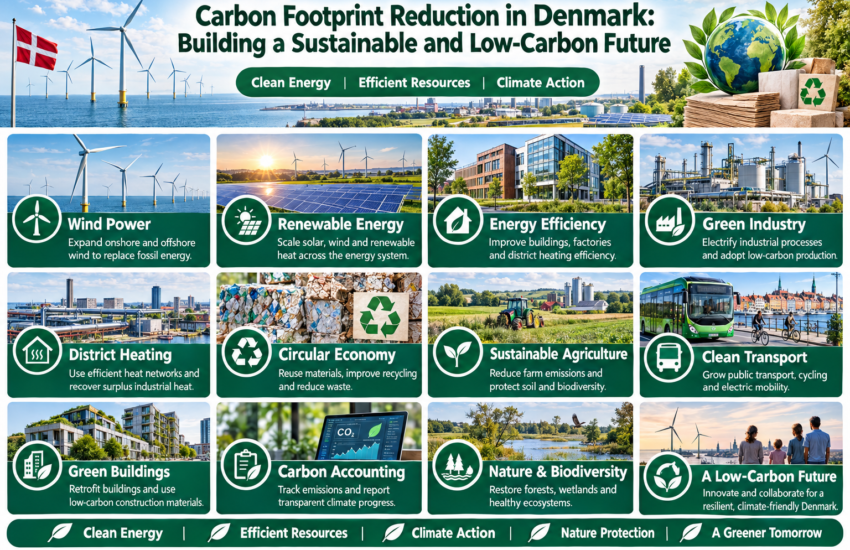
Carbon footprint reduction in Denmark is an essential part of building a sustainable, competitive, and climate-resilient economy. Renewable energy, sustainable manufacturing, cleaner transportation, energy-efficient buildings, improved agricultural practices, and circular resource management all contribute to this transition.
Businesses have an important role to play by measuring their emissions, identifying opportunities for improvement, and integrating carbon management into everyday decision-making. Accurate reporting, credible sustainability initiatives, and continuous monitoring can help organisations demonstrate progress while improving operational efficiency.
Denmark’s continued transition towards a low-carbon future depends on cooperation between policymakers, industries, communities, and consumers. By combining technological innovation with responsible resource use and measurable environmental action, the country can strengthen its sustainability leadership and support a future in which economic development and environmental protection advance together.