The textiles and apparel industry is an essential part of the global economy, connecting farmers, fiber producers, manufacturers, brands, retailers, logistics providers, and consumers. At the same time, the industry faces increasing pressure to address its environmental impact. From raw material production and spinning to dyeing, finishing, garment manufacturing, transportation, and end-of-life management, every stage of the value chain can contribute to Carbon Emissions.
As sustainability expectations continue to grow, textile and apparel companies are increasingly focusing on Carbon Footprint Reduction, responsible sourcing, energy efficiency, and cleaner production. Moving toward a lower-carbon business model is not simply an environmental responsibility. It can also improve operational efficiency, strengthen relationships with global customers, support market access, and build long-term business resilience.
Understanding the Carbon Footprint of Textiles and Apparel
The Carbon Footprint of a textile or apparel company represents the greenhouse gas emissions associated with its operations and wider value chain. Understanding these emissions is the first step toward effective Decarbonization.
Textile manufacturing can involve energy-intensive activities such as spinning, weaving, knitting, dyeing, washing, drying, printing, and finishing. Fuel used in boilers and other industrial equipment can create direct emissions, while electricity purchased from the grid can contribute indirectly to the company’s environmental impact.
These emissions can be categorized into Scope 1 Emissions, Scope 2 Emissions, and Scope 3 Emissions.
Scope 1 Emissions are generated directly by sources controlled by the organization, such as industrial boilers, furnaces, generators, and company-owned vehicles. Companies can address these emissions through fuel switching, equipment modernization, process optimization, and cleaner technologies.
Scope 2 Emissions are associated with purchased electricity, heating, cooling, and steam. Textile facilities can reduce these emissions by improving energy efficiency and increasing their use of renewable electricity.
Scope 3 Emissions cover emissions throughout the wider value chain. For apparel companies, these can represent a significant sustainability challenge because they may include raw materials, purchased goods, transportation, packaging, supplier activities, product distribution, product use, and end-of-life treatment.
Renewable Energy and Clean Energy in Textile Manufacturing
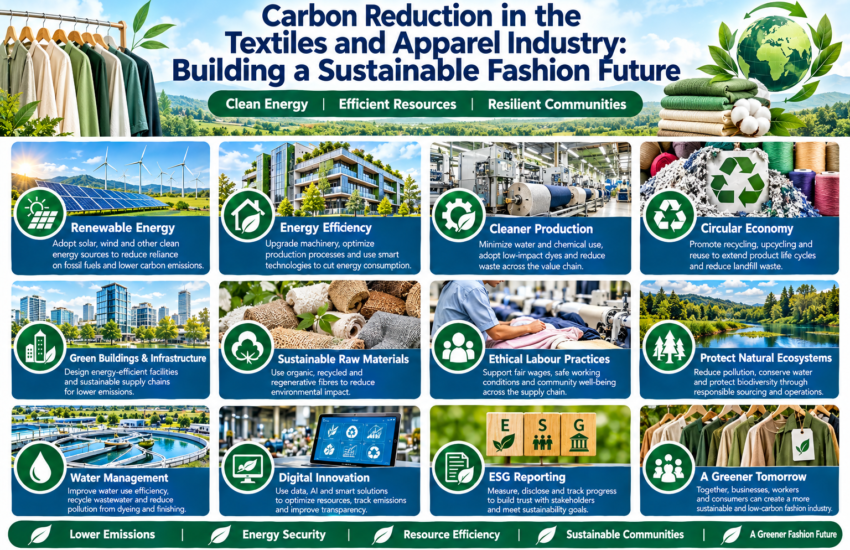
The transition toward Renewable Energy is becoming increasingly important for textile and apparel manufacturers. Facilities can explore solar power, wind energy, renewable electricity procurement, biomass, and other suitable clean-energy solutions.
Solar energy can be particularly useful for manufacturing facilities with suitable rooftop or nearby space. Renewable electricity can also help companies reduce their dependence on conventional energy sources and lower their Scope 2 Emissions.
The adoption of Clean Energy should be combined with energy efficiency. Replacing inefficient machinery, improving heating and cooling systems, optimizing compressed-air systems, reducing heat losses, and implementing smart energy monitoring can help reduce energy consumption.
A successful Energy Transition is therefore not only about changing the source of energy. It also involves using energy more efficiently and integrating sustainability into everyday manufacturing decisions.
Decarbonization Across the Apparel Value Chain
Decarbonization requires a comprehensive approach because emissions occur throughout the textile and apparel value chain. Companies should examine their raw materials, manufacturing processes, logistics, packaging, and product life cycle.
Material selection can have an important role in reducing environmental impact. Businesses can explore recycled fibers, responsibly sourced natural fibers, lower-impact materials, and innovative alternatives where technically and commercially appropriate.
Manufacturing processes can also be redesigned to reduce energy and resource consumption. Efficient dyeing technologies, water-saving processes, low-temperature treatments, heat recovery, and improved production planning can contribute to lower emissions.
Digital manufacturing and data-driven energy management can further support carbon reduction by helping companies identify inefficient processes and monitor improvements.
Addressing Supply Chain Emissions
One of the biggest challenges for the apparel industry is managing Supply Chain Emissions. Brands and manufacturers often depend on extensive networks of suppliers, making it difficult to directly control environmental performance across the entire value chain.
Companies can address this challenge by engaging suppliers and establishing sustainability expectations. Supplier assessments can include energy consumption, emissions management, renewable energy adoption, waste management, and environmental policies.
Collaboration can be more effective than simply imposing requirements. Textile brands can work with suppliers to identify practical energy-efficiency measures, encourage Renewable Energy adoption, and share sustainability knowledge.
This approach supports the development of a Green Supply Chain, where environmental performance becomes part of procurement, production, logistics, and supplier management.
Building a Green Supply Chain
A Green Supply Chain extends sustainability beyond the factory. It considers the environmental impact of raw materials, transportation, packaging, warehousing, manufacturing, and distribution.
Companies can review transportation routes, consolidate shipments, optimize logistics, reduce unnecessary packaging, and explore lower-emission transportation solutions.
Sustainable sourcing can also support carbon reduction. Selecting suppliers that use cleaner energy and demonstrate responsible environmental practices can help companies address their wider Scope 3 Emissions.
A green supply chain can also create business benefits by improving resource efficiency, reducing waste, strengthening supplier relationships, and responding to increasing sustainability expectations from customers.
Carbon Credits and Carbon Offset Strategies
While reducing emissions at source should remain the priority, some residual emissions may be difficult to eliminate immediately. In such situations, companies may consider Carbon Credits as part of a broader climate strategy.
Carbon credits can support projects associated with activities such as renewable energy, forest conservation, restoration, or other verified emission-reduction initiatives. Companies should carefully evaluate the credibility, transparency, and environmental integrity of the credits they use.
A Carbon Offset should complement actual emissions reduction rather than substitute for it. Businesses should first prioritize energy efficiency, renewable energy, cleaner production, sustainable sourcing, and supply-chain improvements.
The long-term objective should be to minimize unavoidable emissions while maintaining transparency about the role of offsets and carbon credits.
Sustainability Reporting and ESG Reporting
Transparency is becoming increasingly important in the textile and apparel industry. Sustainability Reporting allows companies to communicate their environmental performance, sustainability initiatives, progress, and future objectives to stakeholders.
ESG Reporting provides a broader framework for communicating environmental, social, and governance performance. For textile and apparel companies, this may include carbon emissions, energy consumption, water use, waste management, responsible sourcing, labor practices, and supply-chain sustainability.
Reliable emissions data can make sustainability reporting more meaningful. Companies should establish consistent processes for collecting, reviewing, and managing environmental information across their operations and supply chain.
Transparent reporting can also strengthen relationships with international buyers, investors, consumers, and business partners.
ESG Compliance and Global Market Expectations
Sustainability is increasingly becoming an important consideration in global apparel sourcing. International brands and retailers are strengthening environmental requirements for their suppliers, making ESG Compliance increasingly relevant for textile manufacturers.
Companies that can demonstrate effective carbon management, transparent reporting, responsible sourcing, and continuous environmental improvement may be better positioned to meet customer expectations.
Preparing for ESG requirements can also encourage organizations to improve internal processes. Better data management, energy monitoring, supplier engagement, and environmental governance can strengthen both compliance and operational performance.
Moving Toward a Carbon Neutral Textile Industry
The ambition of becoming Carbon Neutral requires more than purchasing offsets. It requires organizations to progressively reduce emissions across their operations and value chains.
Textile and apparel companies can establish a structured pathway beginning with carbon-footprint assessment, followed by emission reduction planning, clean-energy adoption, supplier engagement, process improvements, and continuous monitoring.
Companies can prioritize the largest sources of emissions and implement practical measures according to their operational capabilities. Progress can then be communicated through sustainability and ESG reporting.
Conclusion
The transition toward a lower-carbon textiles and apparel industry is becoming an important business priority. Companies that understand their Carbon Footprint and actively pursue Carbon Footprint Reduction can improve environmental performance while strengthening competitiveness and resilience.
Addressing Scope 1 Emissions, Scope 2 Emissions, and Scope 3 Emissions requires action across manufacturing operations, energy systems, raw materials, logistics, suppliers, and product life cycles. Renewable Energy, Clean Energy, efficient production, responsible sourcing, and a Green Supply Chain can all contribute to meaningful progress.
The industry’s journey toward Decarbonization is ultimately a continuous process. By combining practical emission-reduction measures with credible Sustainability Reporting, ESG Reporting, and responsible use of Carbon Credits and Carbon Offset mechanisms, textile and apparel companies can move toward a more sustainable and Carbon Neutral future while creating lasting value for businesses, customers, and the environment.