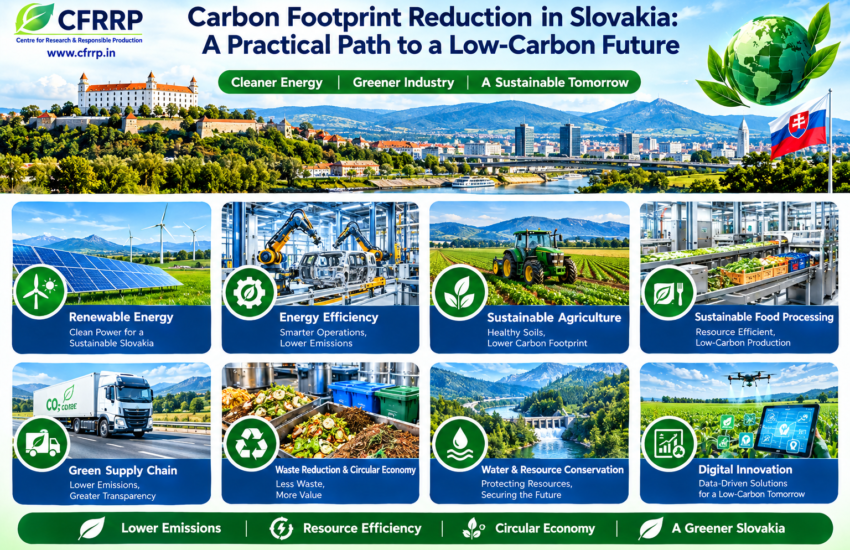
Slovakia is undergoing an important Energy Transition as businesses, industries, and public institutions respond to climate targets, changing energy markets, and growing expectations around environmental responsibility. As a member of the European Union, Slovakia is working toward reducing Carbon Emissions while improving energy efficiency, expanding Renewable Energy, and encouraging sustainable business practices.
For organizations operating in Slovakia, Carbon Footprint Reduction is no longer limited to environmental initiatives. It increasingly connects with operational efficiency, investor expectations, ESG Compliance, regulatory requirements, and long-term business resilience.
1. Understanding the Carbon Footprint in Slovakia
A company’s Carbon Footprint represents the greenhouse gas emissions associated with its operations, energy consumption, transportation, products, and supply chain. Measuring these emissions provides organizations with a baseline from which they can identify reduction opportunities.
The most common framework divides emissions into three categories:
- Scope 1 Emissions – Direct emissions from sources owned or controlled by an organization, such as company vehicles, industrial processes, and on-site fuel combustion.
- Scope 2 Emissions – Indirect emissions associated with purchased electricity, heating, cooling, or steam.
- Scope 3 Emissions – Other indirect emissions throughout the value chain, including suppliers, transportation, business travel, purchased goods, product use, and waste.
Understanding all three scopes enables Slovak companies to develop more comprehensive strategies for reducing their overall environmental impact.
2. Renewable Energy and Clean Energy
One of the most important opportunities for Carbon Footprint Reduction in Slovakia is the transition toward Clean Energy.
Solar power, hydro power, biomass, and other forms of Renewable Energy can help organizations reduce their dependence on fossil fuels. Businesses can install solar panels at their facilities, purchase electricity from renewable sources, or enter into suitable renewable energy agreements.
Switching to cleaner electricity can have a particularly important effect on Scope 2 Emissions. At the same time, improving energy efficiency through modern equipment, building upgrades, smart energy management, and efficient heating systems can further reduce energy consumption.
The combination of energy efficiency and renewable electricity can therefore become a central part of corporate Decarbonization strategies.
3. Tackling Scope 1 Emissions
Reducing Scope 1 Emissions requires organizations to examine activities that directly generate greenhouse gases.
For manufacturers, this may involve upgrading production equipment, improving industrial processes, replacing fossil-fuel boilers, and recovering waste heat. Companies with vehicle fleets can gradually transition toward electric or other lower-emission alternatives.
Energy audits can help businesses identify where fuel is being wasted and which investments could deliver measurable emission reductions. These measures can also reduce operating costs, making decarbonization relevant from both environmental and business perspectives.
4. Addressing Scope 2 Emissions
Electricity and purchased energy can represent a significant portion of corporate emissions. Companies seeking to reduce Scope 2 Emissions can combine energy efficiency with renewable electricity procurement.
Businesses can improve lighting systems, heating and cooling controls, insulation, machinery efficiency, and building management systems. Where feasible, purchasing renewable electricity can complement these improvements.
Monitoring energy use across facilities is also essential. Digital energy-management systems can provide organizations with better information about consumption patterns and help identify opportunities for continuous improvement.
5. Reducing Supply Chain Emissions
For many companies, Supply Chain Emissions can represent a substantial share of their total environmental impact. These emissions fall primarily within Scope 3 Emissions, making supply-chain management a critical element of corporate decarbonization.
Slovak businesses can work with suppliers to improve energy efficiency, increase renewable energy use, reduce packaging, optimize transportation, and introduce more sustainable materials.
Developing a Green Supply Chain can also involve selecting suppliers according to environmental criteria and incorporating sustainability requirements into procurement policies.
Companies should avoid focusing only on their own facilities. Collaboration with suppliers, logistics providers, customers, and other business partners can produce broader and more meaningful emission reductions.
6. Carbon Credits and Carbon Offsets
After implementing direct reduction measures, companies may consider market-based approaches such as Carbon Credits and Carbon Offset programs.
A carbon credit generally represents a quantified reduction, removal, or avoidance of greenhouse gas emissions under a particular system or standard. Carbon offsets may be used to compensate for certain residual emissions by supporting eligible climate projects.
However, offsets should not replace direct Carbon Footprint Reduction efforts. Organizations should first prioritize energy efficiency, renewable energy, process improvements, and other genuine emission-reduction measures.
The credibility, verification, additionality, and transparency of any carbon-credit or offset program should also be carefully evaluated.
7. Sustainability Reporting and ESG Reporting
Measuring emissions is increasingly connected with corporate transparency. Sustainability Reporting allows organizations to communicate their environmental and social performance to stakeholders.
Similarly, ESG Reporting provides information about environmental, social, and governance factors that may influence business performance and risk.
For Slovak companies, accurate emissions data can support reporting processes and help demonstrate progress toward climate objectives. Organizations should establish reliable systems for collecting energy, fuel, transportation, procurement, and other relevant data.
Good-quality data can also make it easier to identify areas where emission-reduction investments could have the greatest impact.
8. Carbon Neutral Goals and Long-Term Decarbonization
Some organizations aim to become Carbon Neutral by balancing remaining emissions with appropriate reductions or removals. Achieving credible climate goals requires more than purchasing offsets.
A strong strategy should establish measurable targets, define a baseline year, monitor progress, and prioritize actual emission reductions. Companies can gradually reduce fossil-fuel consumption, increase renewable energy adoption, improve resource efficiency, and address value-chain emissions.
This approach makes Decarbonization an ongoing business process rather than a one-time environmental campaign.
9. The Role of ESG Compliance
Environmental expectations are becoming increasingly relevant to corporate governance and risk management. ESG Compliance requires organizations to understand applicable requirements, maintain appropriate data, and demonstrate responsible management of environmental impacts.
For companies operating in Slovakia and supplying customers across Europe, sustainability performance can also influence relationships with multinational customers and business partners.
Organizations that establish robust environmental data systems today can be better positioned to respond to evolving reporting requirements and stakeholder expectations.
The Future of Carbon Footprint Reduction in Slovakia
Slovakia’s path toward lower emissions will depend on coordinated action across businesses, government, communities, and supply chains. Renewable Energy, energy efficiency, cleaner transportation, industrial innovation, and responsible procurement can all contribute to the country’s broader Energy Transition.
For businesses, the starting point should be clear: measure the Carbon Footprint, identify Scope 1 Emissions, Scope 2 Emissions, and Scope 3 Emissions, and establish practical reduction targets.
From there, organizations can invest in Clean Energy, build a Green Supply Chain, strengthen Sustainability Reporting and ESG Reporting, and use Carbon Credits or Carbon Offset mechanisms only where appropriate for residual emissions.
Ultimately, effective Carbon Footprint Reduction is about integrating climate action into everyday business decisions. For Slovak organizations, this can support environmental goals while improving energy efficiency, strengthening resilience, and preparing businesses for an increasingly low-carbon European economy.