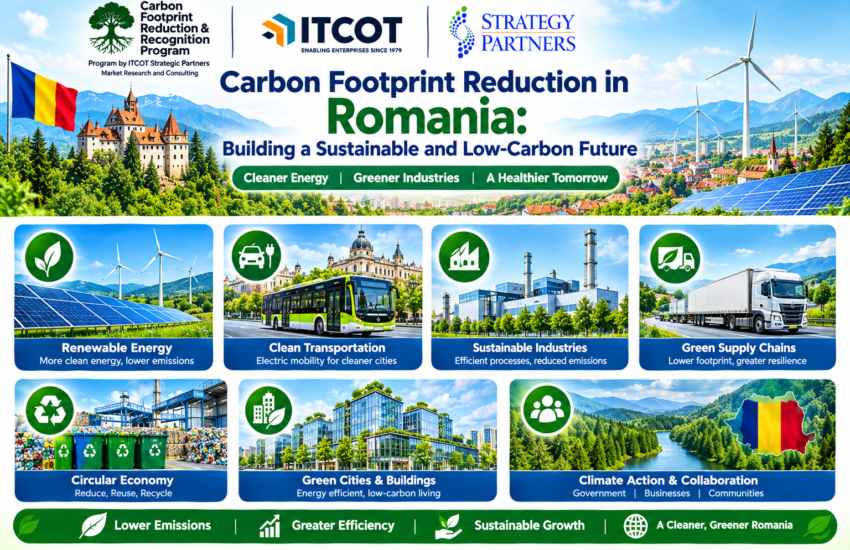
Romania is undergoing an important transformation toward a cleaner, more sustainable and resilient economy. As part of the European energy and climate transition, businesses across the country are increasingly focusing on Carbon Footprint Reduction, energy efficiency, renewable power and responsible resource management.
For Romanian businesses, reducing environmental impact is no longer simply an environmental objective. It is becoming an important part of business strategy, operational efficiency, supply-chain management and long-term competitiveness. Companies are increasingly expected to understand their environmental impact, measure their Carbon Emissions, establish reduction strategies and communicate their progress transparently.
Understanding the Carbon Footprint of Romanian Businesses
A company’s Carbon Footprint represents the greenhouse gas emissions generated through its operations and wider value chain. These emissions can originate from manufacturing processes, electricity consumption, transportation, heating, cooling, purchased materials, logistics and other business activities.
Understanding emissions across different sources helps organizations identify the areas where the greatest opportunities for reduction exist.
Scope 1 Emissions are directly generated from sources owned or controlled by an organization. These can include fuel combustion in industrial equipment, boilers, furnaces and company-owned vehicles.
Scope 2 Emissions are associated with purchased electricity, heating, cooling or steam consumed by an organization. For many Romanian businesses, transitioning toward renewable electricity can be an important strategy for reducing these emissions.
Scope 3 Emissions arise throughout the wider value chain. They can include purchased goods and services, transportation, employee commuting, business travel, waste, distribution and the use or disposal of products.
A comprehensive emissions strategy should therefore consider the entire organizational footprint rather than focusing only on emissions generated within company facilities.
Renewable Energy Supporting Romania’s Energy Transition
Renewable Energy is an important component of Romania’s transition toward a lower-carbon economy. Solar, wind, hydro and other clean energy sources can help businesses reduce their dependence on carbon-intensive energy sources.
Romanian companies can integrate renewable energy into their operations through rooftop solar installations, renewable electricity procurement, power purchase agreements and other clean-energy solutions.
The adoption of Clean Energy can provide environmental benefits while also supporting greater energy resilience. Businesses that generate renewable electricity on-site can potentially reduce their dependence on conventional electricity sources and improve control over long-term energy costs.
For organizations with energy-intensive operations, combining renewable energy with energy-efficiency measures can create a strong foundation for Decarbonization.
Energy Efficiency and Carbon Footprint Reduction
Energy efficiency is one of the most practical approaches to Carbon Footprint Reduction. Reducing unnecessary energy consumption can lower both operating costs and emissions.
Romanian companies can improve efficiency through modern industrial equipment, energy-efficient motors, smart building systems, efficient lighting, heat recovery, insulation and digital energy-monitoring systems.
Manufacturing organizations can also examine production processes to identify energy losses and opportunities for optimization. Better maintenance, process automation and energy monitoring can help companies understand where energy is being consumed and where improvements can be made.
Energy efficiency should therefore be considered alongside renewable energy as a core component of corporate Decarbonization strategies.
Decarbonization Across Romanian Industries
The pathway toward Decarbonization differs across industries.
Manufacturing companies can reduce emissions through renewable electricity, process optimization, electrification and low-carbon materials. Heavy industries may need to explore alternative fuels, process innovation and advanced technologies to address emissions that are difficult to eliminate.
The transportation and logistics sector can reduce Carbon Emissions through electric vehicles, route optimization, improved fleet management and more efficient logistics networks.
Commercial buildings can contribute by adopting efficient heating and cooling systems, renewable power, smart energy management and improved building insulation.
Agriculture and food-processing businesses can explore resource efficiency, renewable energy, waste reduction and sustainable production practices.
The most effective strategy is one that considers the specific operational characteristics and emission sources of each industry.
Managing Supply Chain Emissions
For many organizations, a significant share of their environmental impact can occur outside their own facilities. This makes Supply Chain Emissions an increasingly important area of focus.
Companies can work with suppliers to improve emissions data collection, identify carbon-intensive materials and encourage the adoption of renewable energy and efficient production practices.
Procurement teams can incorporate environmental performance into supplier evaluation. Organizations can also work with logistics partners to reduce transportation emissions through route optimization, efficient vehicles and improved load management.
Creating a Green Supply Chain can help organizations reduce emissions while improving resource efficiency and strengthening relationships with environmentally responsible suppliers.
Sustainability Reporting and ESG Reporting
Reliable environmental data is essential for effective climate management. Sustainability Reporting enables organizations to communicate their environmental performance, climate initiatives, resource consumption and progress toward sustainability objectives.
ESG Reporting provides a broader framework covering environmental, social and governance considerations. Carbon emissions, energy consumption, renewable energy adoption, climate risks and emissions-reduction initiatives are important components of corporate ESG performance.
Transparent reporting can improve stakeholder confidence and help businesses respond to the increasing demand for sustainability information from customers, investors, financial institutions and business partners.
Carbon Credits can play a supporting role in corporate climate strategies. They can be considered for emissions that are technically or economically difficult to eliminate in the short term.
Companies should establish consistent processes for collecting emissions data and monitoring performance across their operations and value chains.
Carbon Credits and Carbon Offset Strategies
However, organizations should prioritize direct emissions reductions. Improving energy efficiency, increasing renewable energy use, reducing fuel consumption and addressing supply-chain emissions should generally form the foundation of a company’s climate strategy.
A Carbon Offset approach can then be considered for appropriate residual emissions, provided the underlying projects demonstrate credible environmental benefits and transparency.
Companies should communicate clearly about the difference between actual emissions reductions and offsetting activities to avoid misleading sustainability claims.
Building a Carbon Neutral Business Strategy
Businesses seeking to become Carbon Neutral should begin by establishing a clear understanding of their emissions sources and organizational boundaries.
A credible carbon-neutral strategy involves measuring the company’s Carbon Footprint, identifying major emission sources, implementing reduction initiatives and addressing appropriate residual emissions.
The emphasis should remain on reducing actual emissions rather than relying primarily on offset mechanisms.
Organizations can progressively integrate climate considerations into operational planning, procurement, capital investment, product development and corporate strategy.
ESG Compliance and Corporate Responsibility
ESG Compliance is becoming increasingly relevant for companies operating within European and international supply chains. Customers, investors and business partners are paying greater attention to corporate environmental performance.
Romanian companies that establish effective carbon-management systems can strengthen their ability to respond to sustainability requirements and demonstrate environmental responsibility.
Strong ESG practices can also support business resilience by encouraging efficient resource use, responsible procurement and better risk management.
Environmental performance is increasingly becoming connected with corporate reputation, market access and long-term competitiveness.
The Role of Businesses in Romania’s Green Transformation
Romania’s transition toward a sustainable economy requires cooperation between businesses, government institutions, financial organizations, technology providers and consumers.
Companies have an important role to play by investing in Clean Energy, improving energy efficiency, reducing Carbon Emissions, managing Supply Chain Emissions and strengthening sustainability governance.
Digital technologies can further support this transition. Energy-monitoring platforms, emissions-management software and data-driven sustainability systems can help companies understand their environmental performance and identify opportunities for improvement.
Businesses can also encourage employees, suppliers and customers to participate in sustainability initiatives, creating a broader culture of environmental responsibility.
Conclusion
Romania’s move toward a low-carbon economy creates significant opportunities for businesses to improve environmental performance while strengthening operational resilience and competitiveness.
Effective Carbon Footprint Reduction requires a comprehensive approach that combines Renewable Energy, energy efficiency, Clean Energy, electrification, responsible procurement and sustainable supply-chain management.
Organizations should consider Scope 1 Emissions, Scope 2 Emissions and Scope 3 Emissions when developing their emissions strategies. Sustainability Reporting, ESG Reporting and ESG Compliance can provide the transparency needed to communicate progress effectively.
Carbon Credits and Carbon Offset mechanisms may support the management of residual emissions, but genuine Decarbonization should remain the central objective.
By embedding carbon management into everyday business decisions, Romanian organizations can contribute to a stronger Energy Transition, develop a Green Supply Chain, reduce their Carbon Footprint and move toward a more sustainable and Carbon Neutral future.