Europe’s carbon footprint energy and power sector is at the forefront of the global transition toward a low-carbon economy. Faced with the urgent need to combat climate change, enhance energy security, and meet ambitious sustainability targets, European nations have accelerated investments in renewable energy, grid modernization, energy efficiency, and innovative low-carbon technologies. The sector, once heavily dependent on coal, oil, and natural gas, is undergoing one of the most significant transformations in its history.
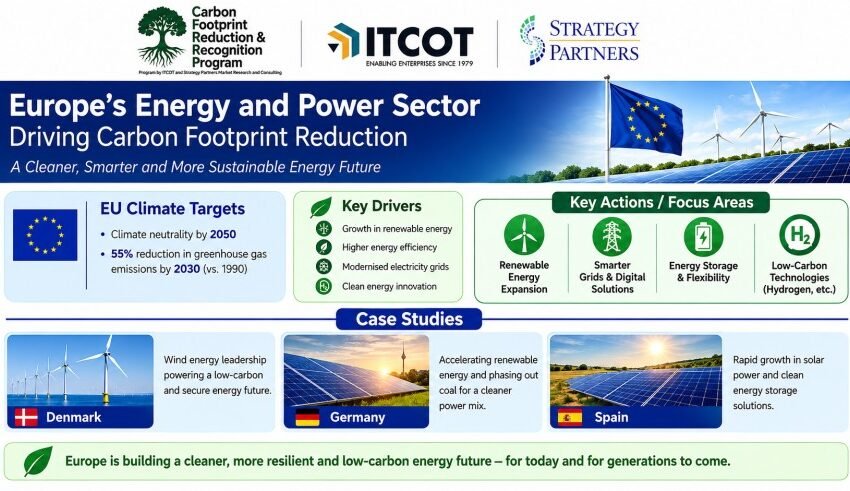
The European Union (EU) has established a legally binding goal of achieving climate neutrality by 2050, with intermediate targets aimed at reducing greenhouse gas emissions by at least 55% by 2030 compared to 1990 levels. Since electricity generation has traditionally been one of the largest contributors to carbon emissions, the energy and power sector has become a critical focus area for carbon footprint reduction initiatives.
The Carbon Challenge in Europe’s Power Sector
Historically, Europe’s industrial growth was powered by fossil fuels. Coal-fired power stations supplied electricity to households, industries, and transportation networks for decades. While these resources enabled economic development, they also contributed significantly to carbon dioxide (CO₂) emissions.
The energy sector accounts for a major share of greenhouse gas emissions due to fuel combustion in power generation. In response, European governments, utilities, and private investors have launched large-scale initiatives to decarbonize electricity production while maintaining grid reliability and affordability.
Several factors are driving this transition:
- Increasing climate commitments and regulatory requirements.
- Rising public demand for clean energy.
- Rapid reductions in renewable energy costs.
- Technological advancements in energy storage and smart grids.
- The need to reduce dependence on imported fossil fuels.
These drivers have reshaped investment priorities across the continent.
Renewable Energy as the Primary Decarbonization Tool
Renewable energy has become the cornerstone of Europe’s carbon reduction strategy. Wind, solar, hydroelectric, and biomass projects are replacing fossil-fuel-based electricity generation at an unprecedented pace.
Offshore wind farms in the North Sea and Baltic Sea have become major contributors to electricity production. Solar power deployment has expanded rapidly across Southern and Central Europe, while hydropower continues to provide stable low-carbon electricity in Nordic countries.
The declining cost of renewable technologies has made clean energy increasingly competitive with conventional fossil fuel generation. As a result, many European countries are closing coal plants earlier than planned and replacing them with renewable alternatives.
Modernizing Electricity Grids
The growth of renewable energy presents new challenges for power system operators because wind and solar generation can vary depending on weather conditions. To address this issue, Europe is investing heavily in smart grids and digital infrastructure.
Advanced monitoring systems, artificial intelligence, and real-time energy management platforms enable utilities to balance supply and demand more efficiently. Cross-border electricity interconnections between European countries also improve grid stability by allowing surplus renewable energy to be shared across regions.
Smart grids help reduce transmission losses, improve energy efficiency, and support the integration of distributed renewable energy sources.
Energy Storage and Flexibility Solutions
One of the biggest challenges in renewable energy deployment is managing intermittency. Europe is therefore investing in large-scale energy storage technologies.
Battery energy storage systems are becoming increasingly common, helping utilities store excess renewable electricity and release it during periods of high demand. Pumped hydro storage remains an important solution in mountainous regions, while hydrogen technologies are emerging as a promising long-duration storage option.
Green hydrogen, produced using renewable electricity, is expected to play a crucial role in decarbonizing not only power generation but also industrial processes and transportation.
Carbon Pricing and Policy Measures
Europe’s Emissions Trading System (ETS) has become one of the world’s most influential carbon reduction mechanisms. The system places a price on carbon emissions, encouraging companies to invest in cleaner technologies.
Higher carbon prices have significantly reduced the economic attractiveness of coal-fired generation. Utilities now face strong financial incentives to shift toward renewable energy and low-carbon solutions.
Additional policies such as renewable energy mandates, energy efficiency standards, green finance initiatives, and sustainability reporting requirements further support the transition.
Case Study 1: Denmark’s Wind Energy Revolution
Denmark has become a global leader in renewable energy through its long-term commitment to wind power development.
Over several decades, Denmark invested heavily in both onshore and offshore wind infrastructure. Today, wind energy supplies a substantial portion of the country’s electricity demand, making it one of the least carbon-intensive power systems in Europe.
The Danish government established supportive regulatory frameworks, encouraged public-private partnerships, and invested in research and innovation. Companies such as Ørsted transformed from fossil-fuel-based utilities into renewable energy leaders.
The Hornsea and other North Sea offshore wind projects demonstrate how large-scale renewable deployment can significantly reduce carbon emissions while supporting economic growth and job creation.
Key Outcomes:
- Significant reduction in fossil fuel dependence.
- Major decrease in electricity sector emissions.
- Strong growth in renewable energy employment.
- Increased energy security through domestic clean energy production.
Denmark’s experience highlights how consistent policy support and long-term planning can accelerate carbon footprint reduction in the energy sector.
Case Study 2: Germany’s Coal Phase-Out Strategy
Germany’s energy transition, known as the Energiewende, represents one of the most ambitious decarbonization programs in Europe.
The country has invested extensively in solar and wind energy while implementing plans to phase out coal-fired power generation. Coal historically played a central role in Germany’s electricity mix, making the transition particularly challenging.
To support the shift, Germany expanded renewable generation capacity, modernized transmission infrastructure, and introduced financial support mechanisms for affected regions and workers.
Large-scale solar installations, offshore wind developments in the North Sea, and increased grid connectivity have helped reduce the country’s carbon intensity.
Key Outcomes:
- Rapid expansion of renewable electricity generation.
- Gradual closure of coal-fired power plants.
- Significant reduction in power sector emissions.
- Development of new green industries and employment opportunities.
Germany’s experience demonstrates the importance of balancing environmental objectives with economic and social considerations during energy transitions.
Case Study 3: Spain’s Solar Energy Transformation
Spain has emerged as one of Europe’s fastest-growing renewable energy markets, particularly in solar power.
Benefiting from abundant sunshine and supportive government policies, Spain has dramatically increased solar photovoltaic capacity over the past decade. Utility-scale solar farms now contribute substantially to national electricity generation.
The country has also encouraged corporate renewable energy procurement, enabling businesses to reduce their carbon footprints through long-term clean energy agreements.
Advanced battery storage projects are increasingly being integrated with solar facilities, enhancing grid flexibility and renewable utilization.
Key Outcomes:
- Rapid growth in solar electricity generation.
- Reduced dependence on fossil fuel imports.
- Lower carbon emissions from power generation.
- Increased investment in clean energy infrastructure.
Spain’s success illustrates how natural resources, supportive policy frameworks, and private-sector participation can work together to accelerate decarbonization.
Future Outlook
Europe’s energy and power sector is expected to continue leading global carbon reduction efforts. Emerging technologies such as green hydrogen, carbon capture and storage, advanced battery systems, artificial intelligence-driven grid management, and next-generation offshore wind projects will further accelerate the transition.
At the same time, challenges remain. Grid modernization, energy affordability, permitting processes, and infrastructure investments require ongoing attention. Balancing sustainability goals with economic competitiveness will be critical as Europe moves toward climate neutrality.
Nevertheless, the progress achieved so far demonstrates that large-scale carbon footprint reduction is both technically feasible and economically beneficial. Through innovation, policy leadership, and collaboration across governments, utilities, industries, and communities, Europe is creating a cleaner, more resilient energy future. The transformation of its energy and power sector serves as a model for countries worldwide seeking to reduce emissions while ensuring reliable and sustainable energy supplies for future generations.